バーチカル・ランドスケープ
東京、そして世の中のあちこちの都会, 2015—2027
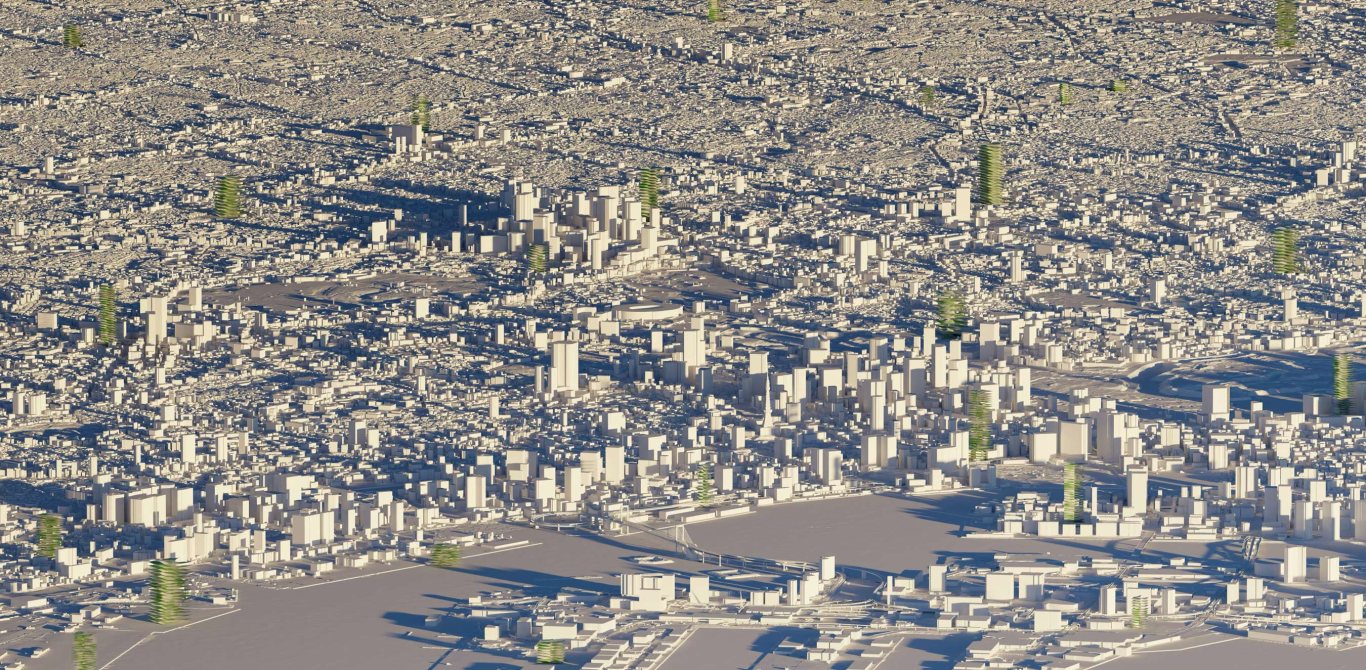
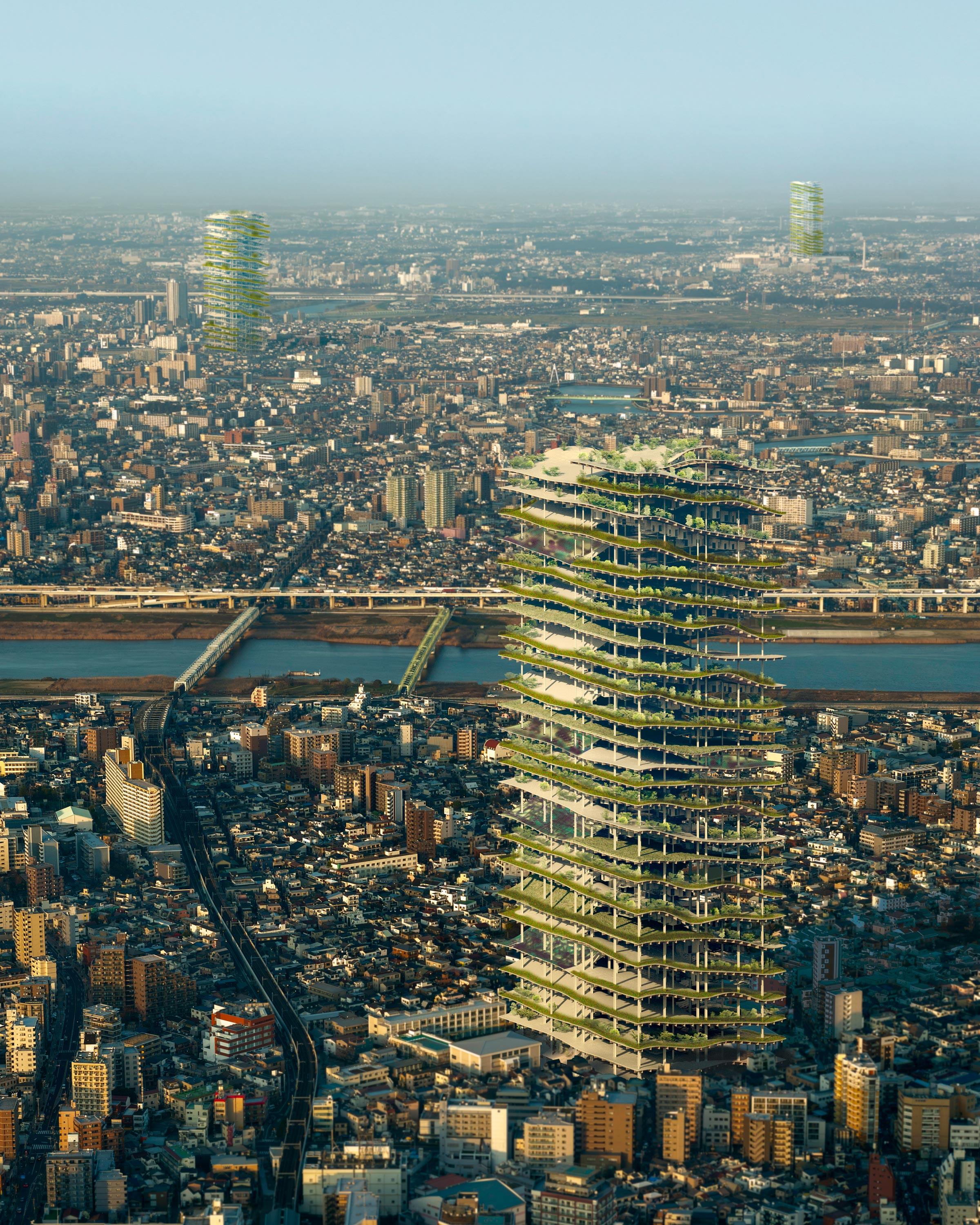
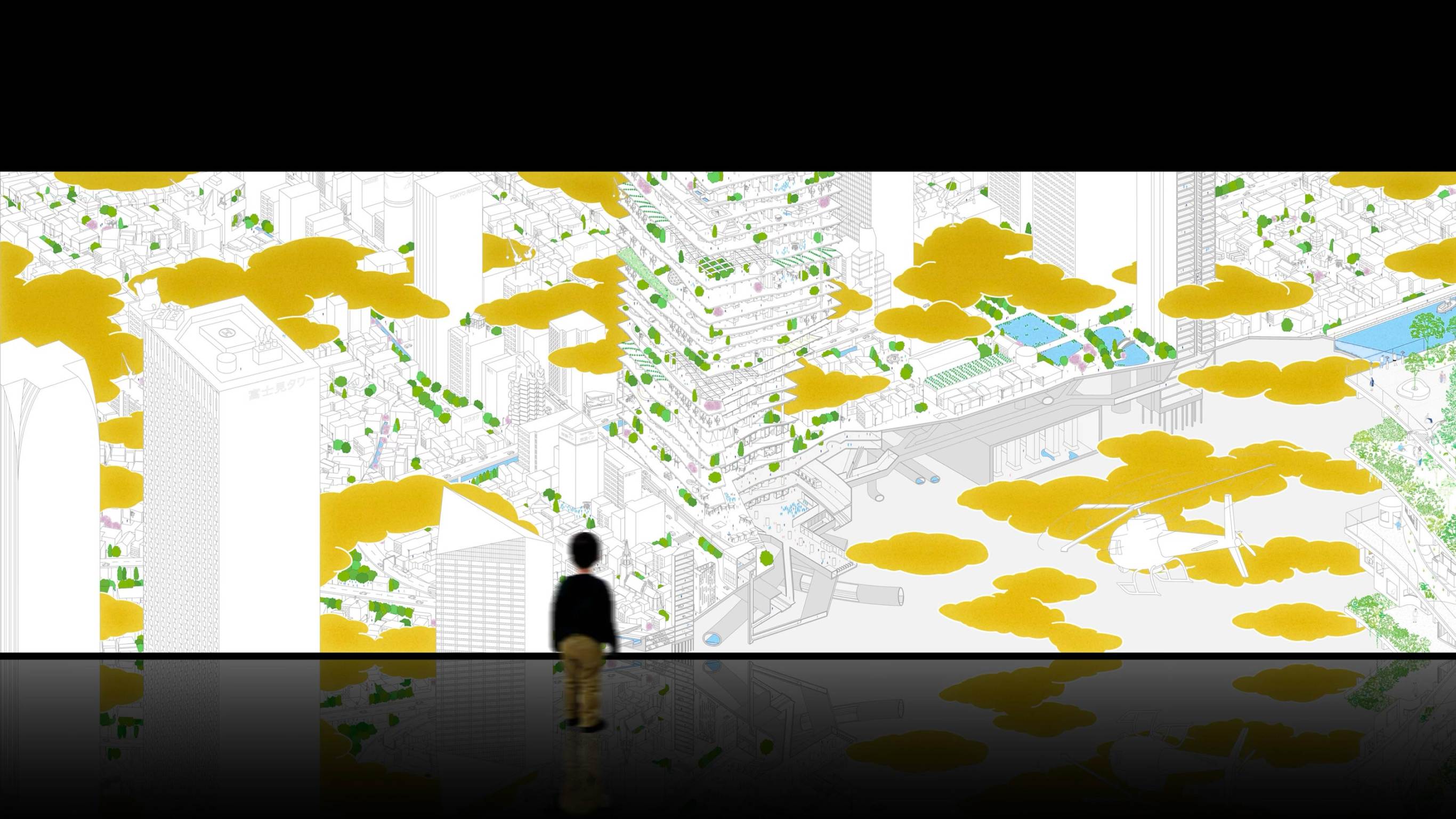
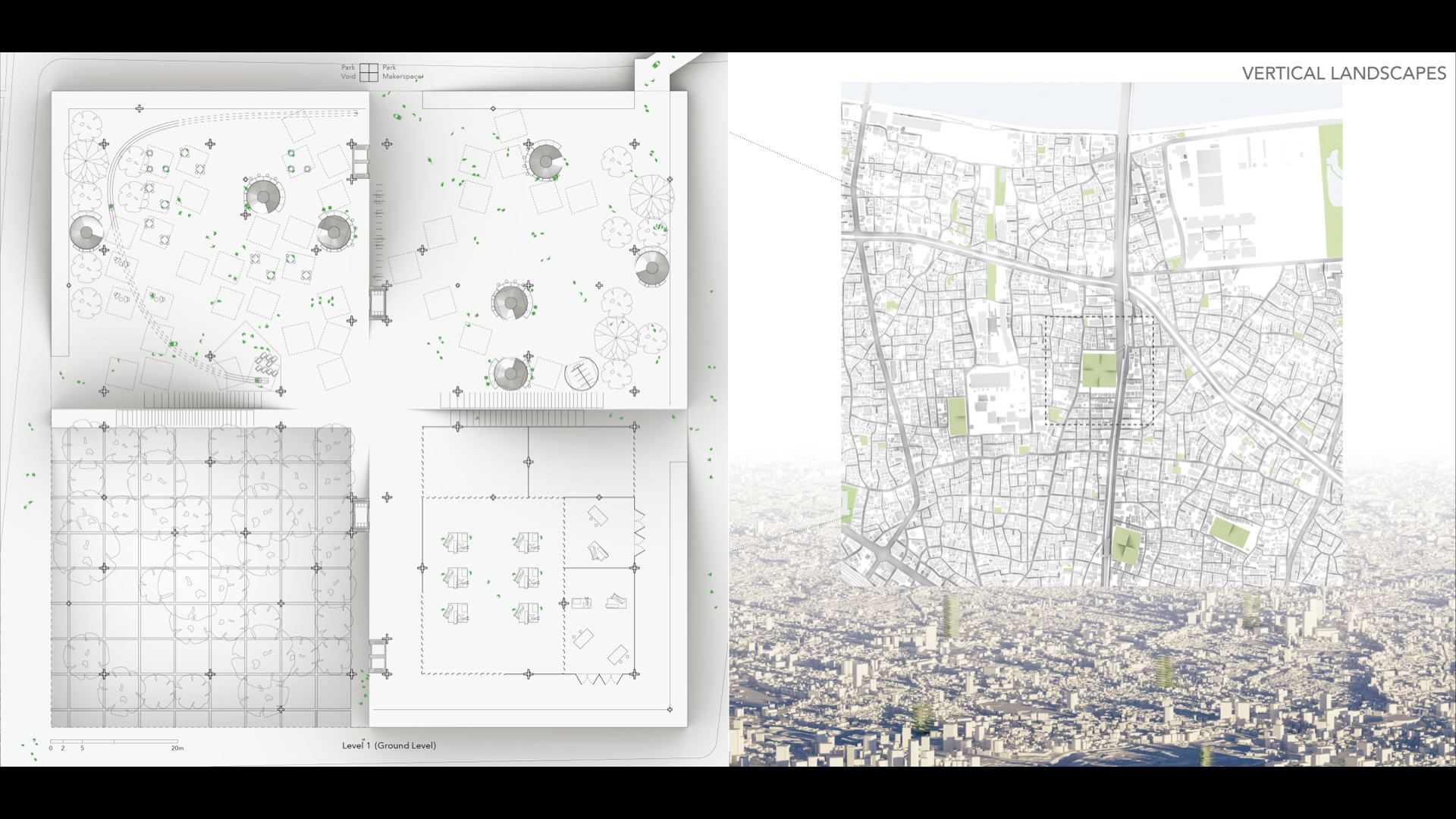
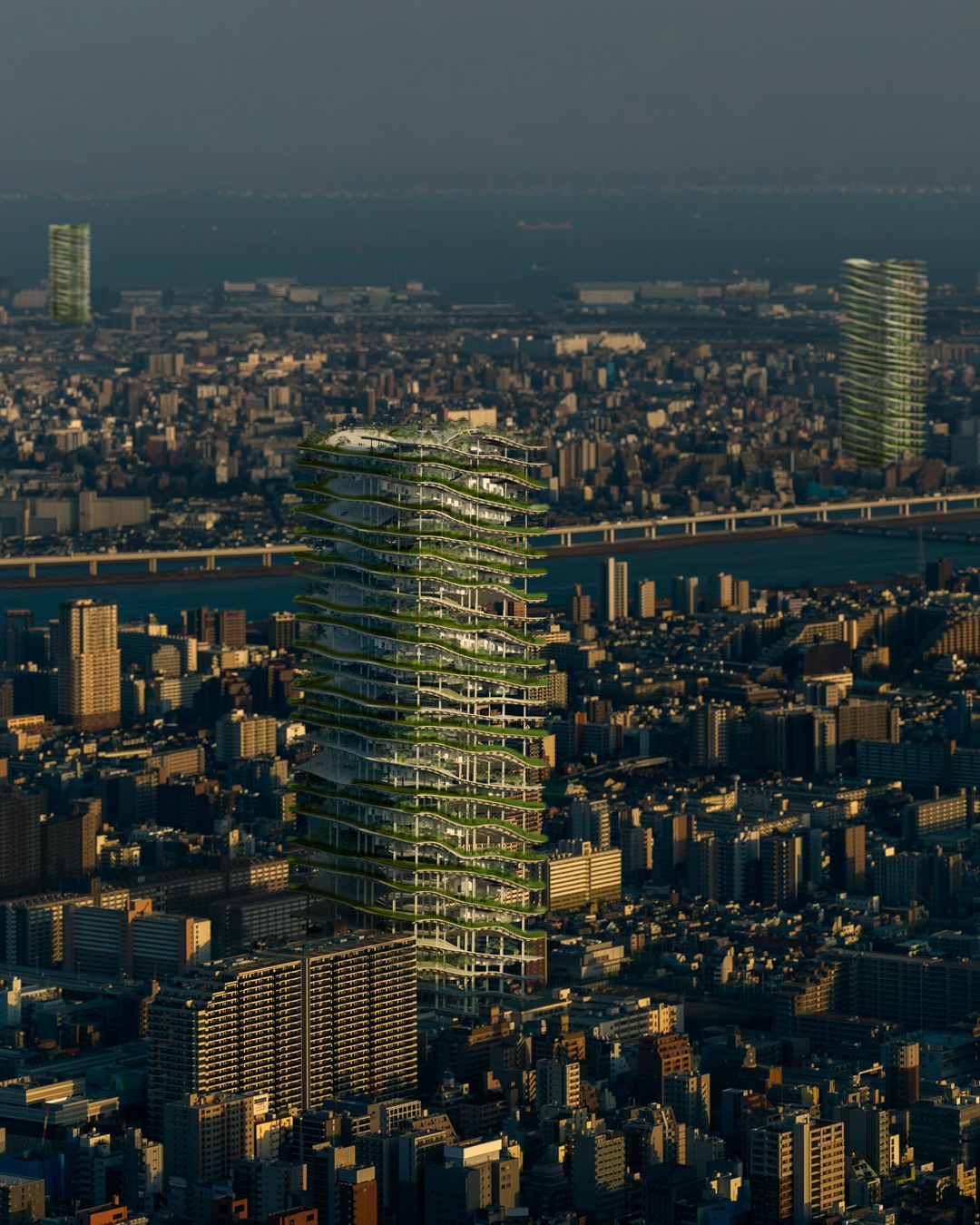
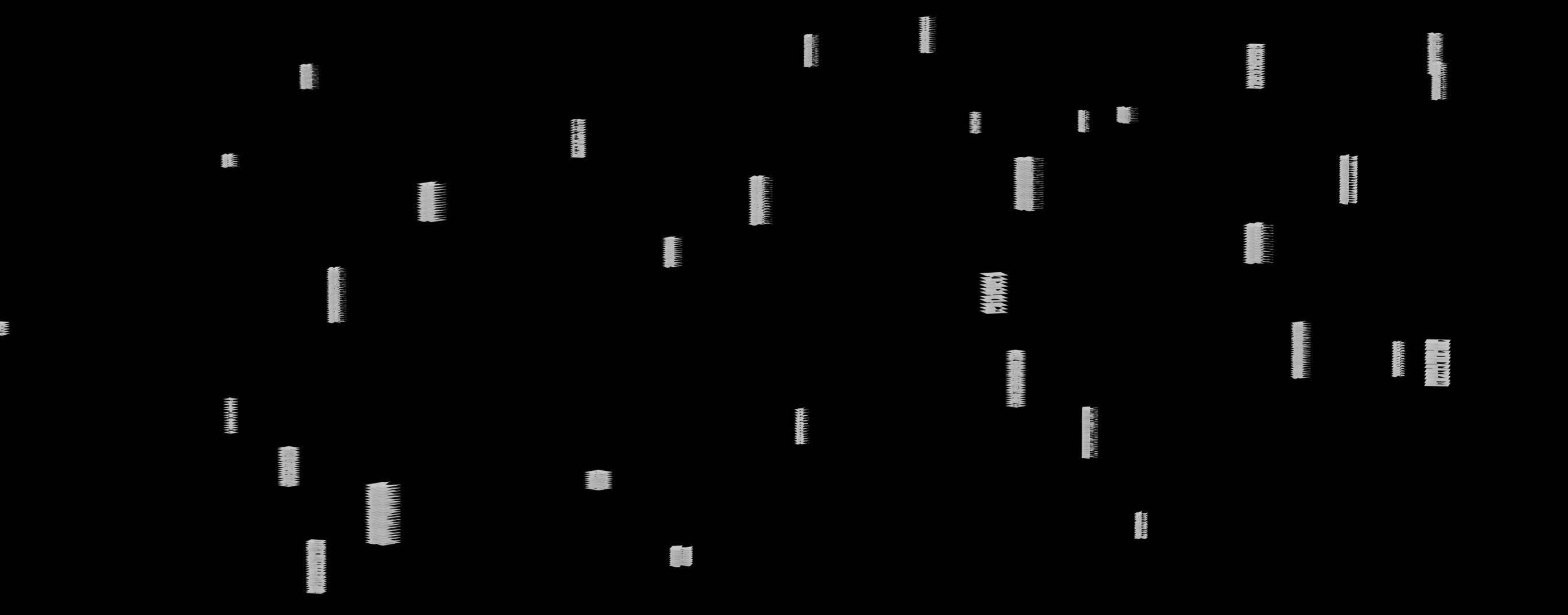
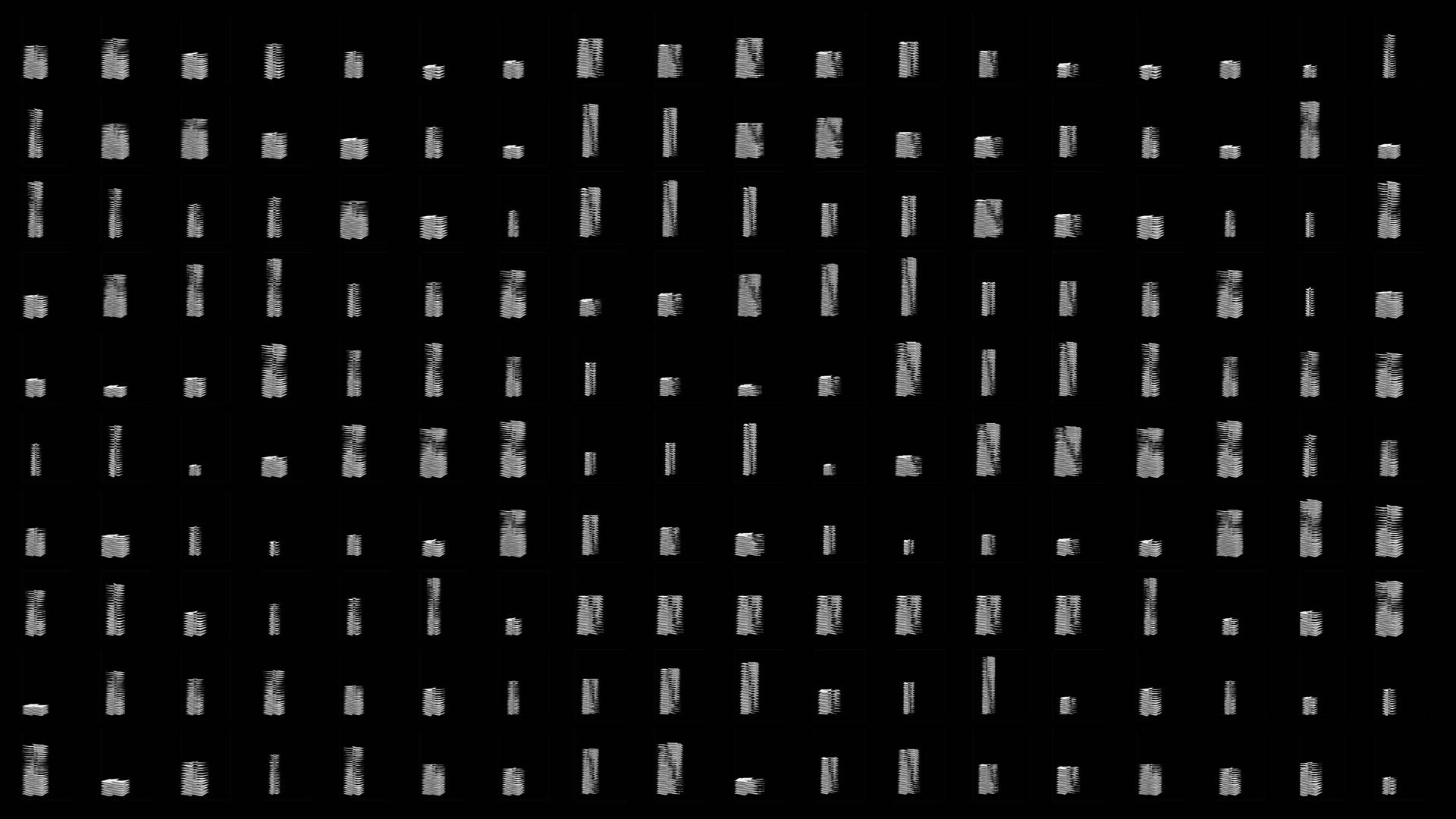
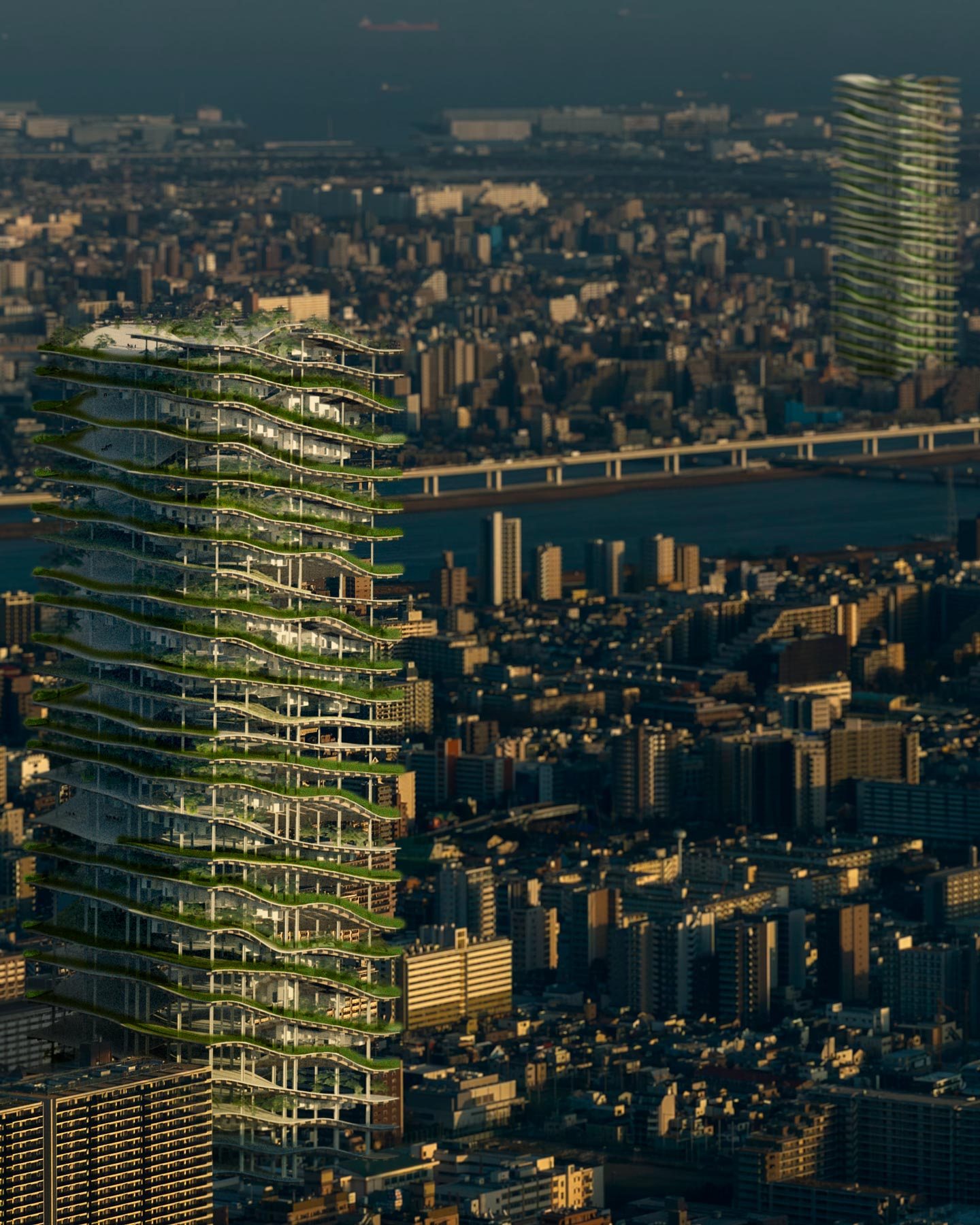
Vertical Landscapes introduce a new urban typology: the continuation of the city’s land —its streets, squares, and parks— in the air. Open to anyone at any time, these urban landscapes are the natural extension of the city’s conditions at ground level.
Vertical Landscapes are not a building. They are infrastructure, multiplying the urban habitat without architecture’s compulsive desire to determine.
Density
Tokyo, where we first formulated Vertical Landscapes over a decade ago, is a conurbation of extreme density. From its beginnings in the early 1600s, when Tokyo was still Edo, the city was already at the forefront of a global trend that has not stopped since: urbanisation.
In 2007, for the first time in human history, the world’s urban population outnumbered the rural. According to the United Nations, 70% of humanity will live in cities by 2050. By 2080, the global population will have grown by another 2.5 billion — more people than the entire world held just three generations ago. To accommodate this growth, the equivalent of 250 megacities would be required: one city of ten million inhabitants every 11 weeks for the coming 55 years.
To minimise our collective CO₂ emissions, density is unavoidable. The question is how urban density is shaped — toward resilience, equity, and sustainable ways of life.
Vertical
In step with technological advances, twentieth-century urbanism embraced the vertical as a means of increasing density. The result, almost without exception, was a spatial cul-de-sac: vertical appendices sealed off from their surroundings.
Today, the vast majority of Tokyo’s high-rise developments remain nondescript versions of “tower with or without plinth,” repeating old mistakes. They are singular, vertically stratified objects, detached from their context, severing the intricate networks of alleys that constitute urban life. Open, freely accessible public space is increasingly punctured and converted into hierarchically controlled zones.
True density, however, is more than floor area ratio. It is an active, interconnected urban fabric.
Diversity
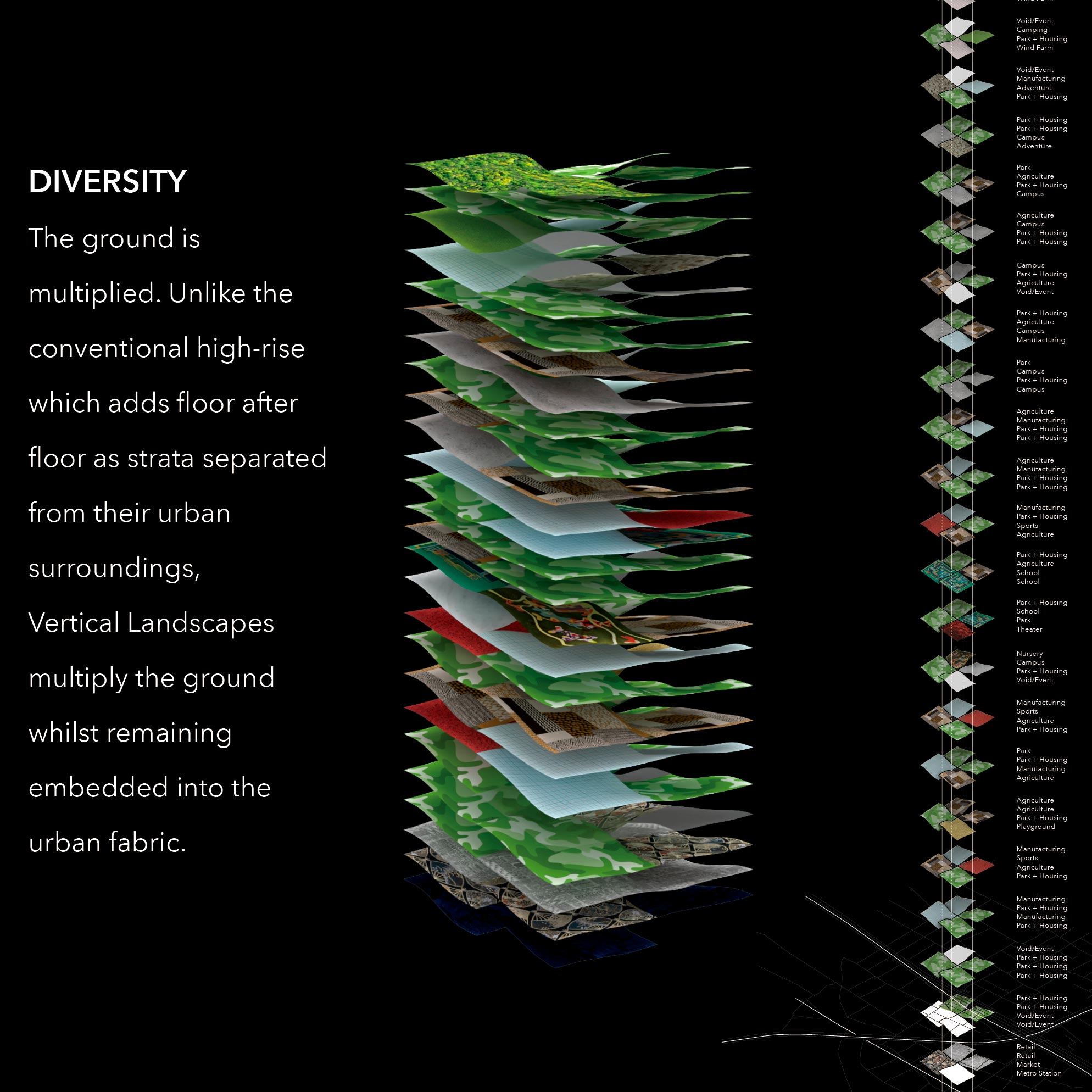
Tokyo’s density embodies diversity in the built. Its vast scale makes Tokyo perhaps the world’s most conclusive example of what it means when differences exist side by side in a symbiosis. This diversity generates the intensity of interwoven systems that keep vast parts of the inner city open and walkable.
Low-rise neighbourhoods sit alongside isolated high-rise developments with expansive green space. These abrupt shifts in scale —continually recalibrating the urban to the human— are at the heart of Tokyo’s success. Diversity here is not stylistic variation but structural coexistence. Differences in scale are not resolved; they remain visible and productive.
Continuity
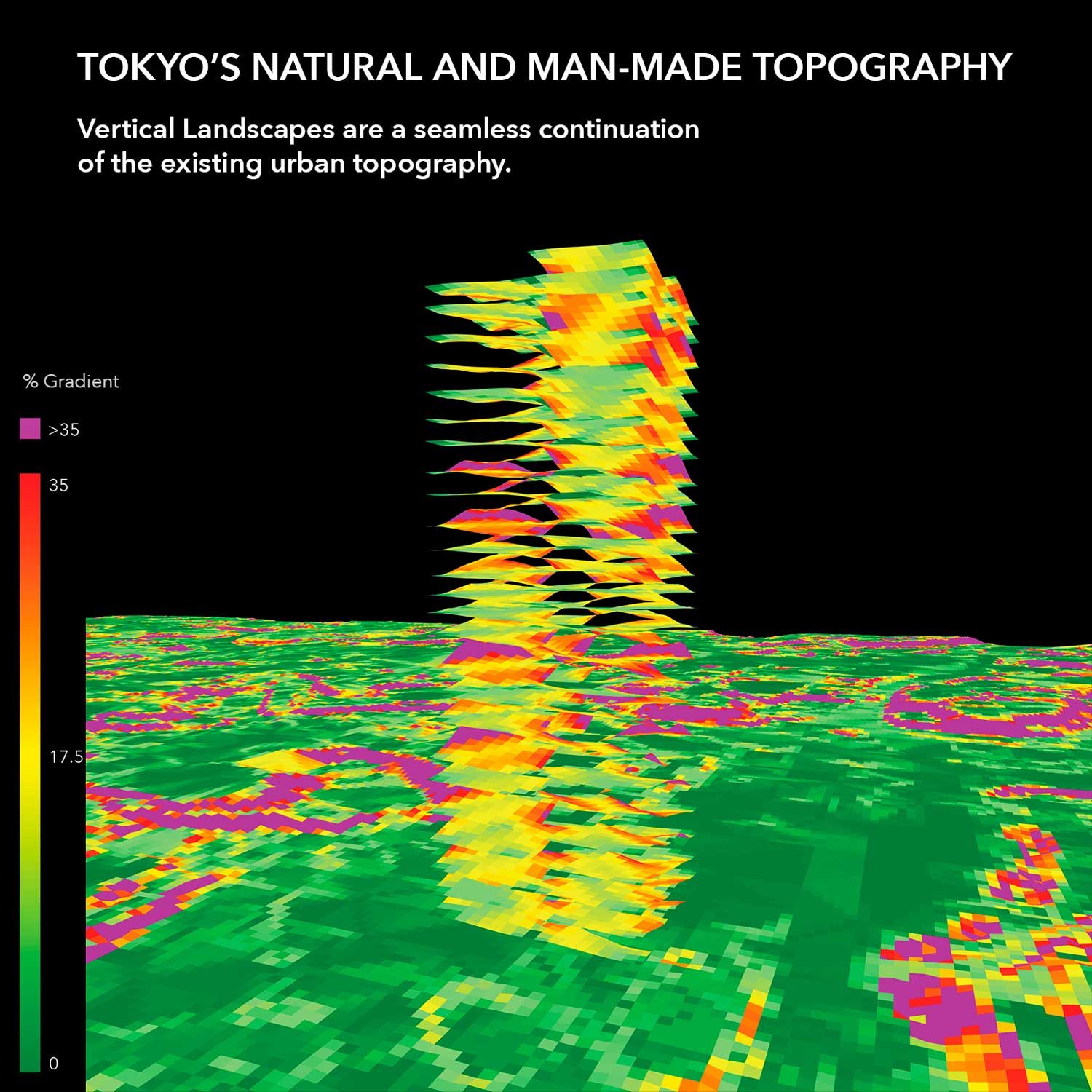
At ground level, Tokyo is a walkable and cycleable network embedded in a complex topography, with natural gradients outside what the building law would permit.
The very conditions that have made Tokyo a unique urban landscape are opportunities for rethinking urbanism — not as top-down masterplanning, but as interventions working from the ground up.
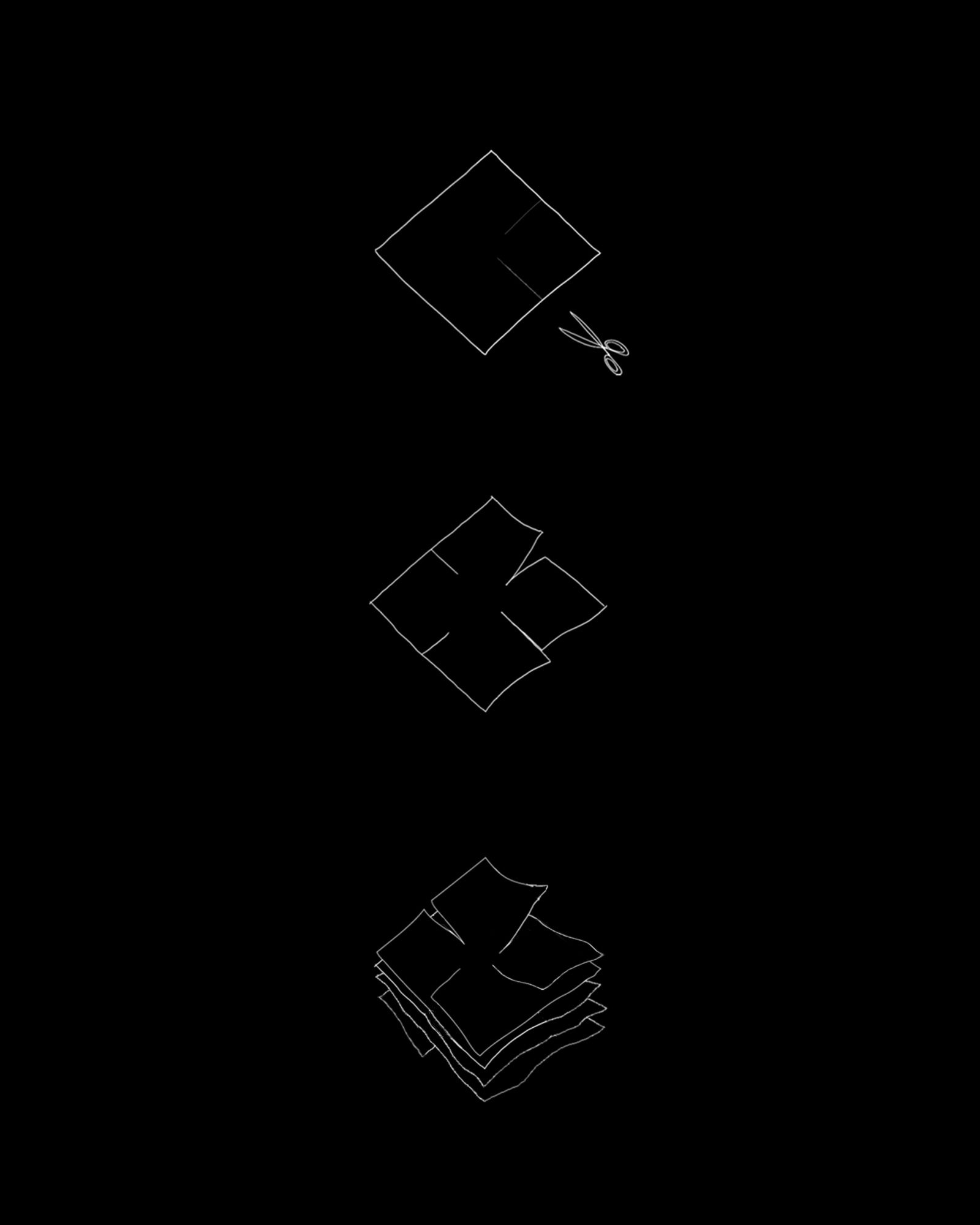
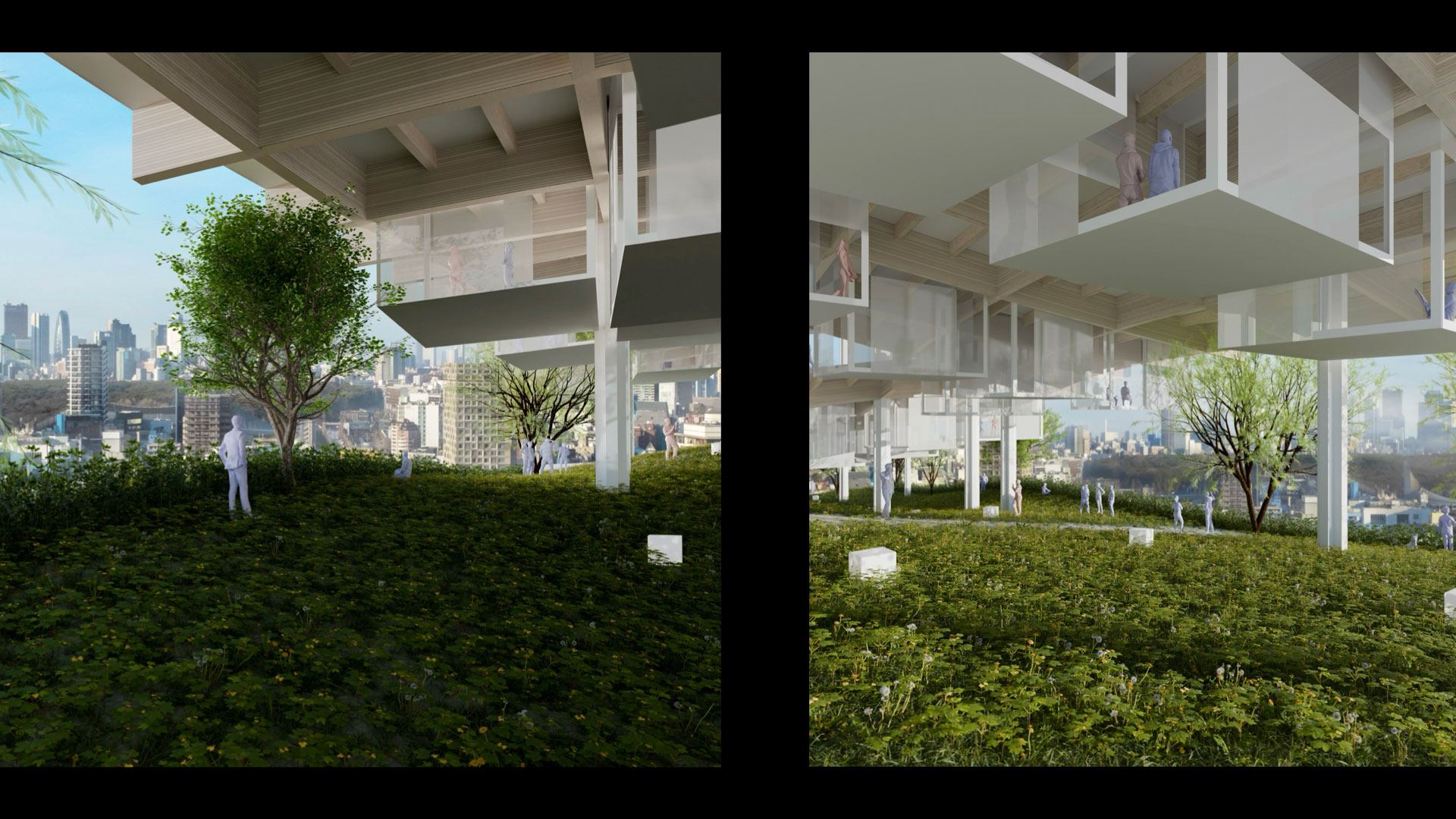
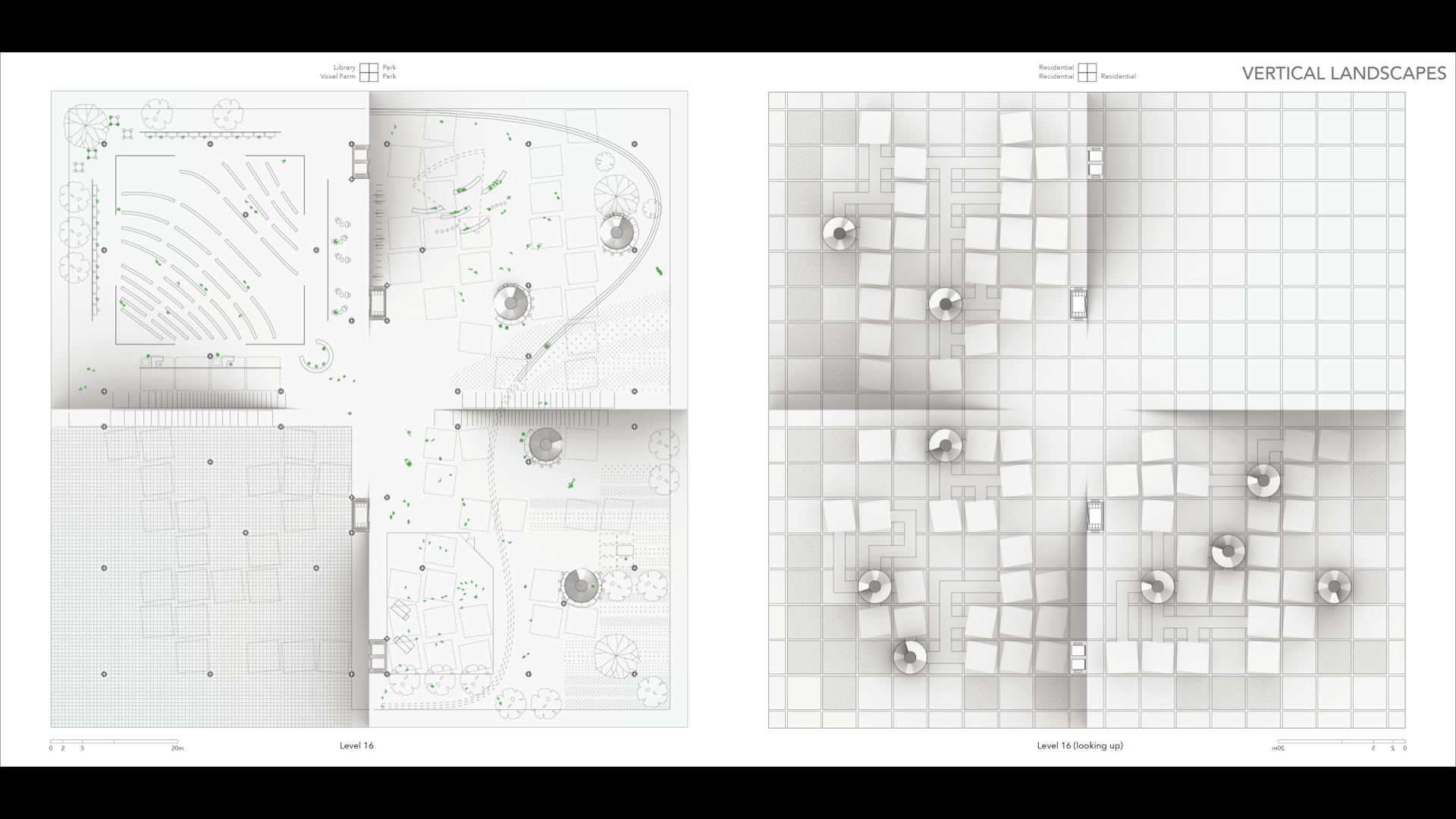
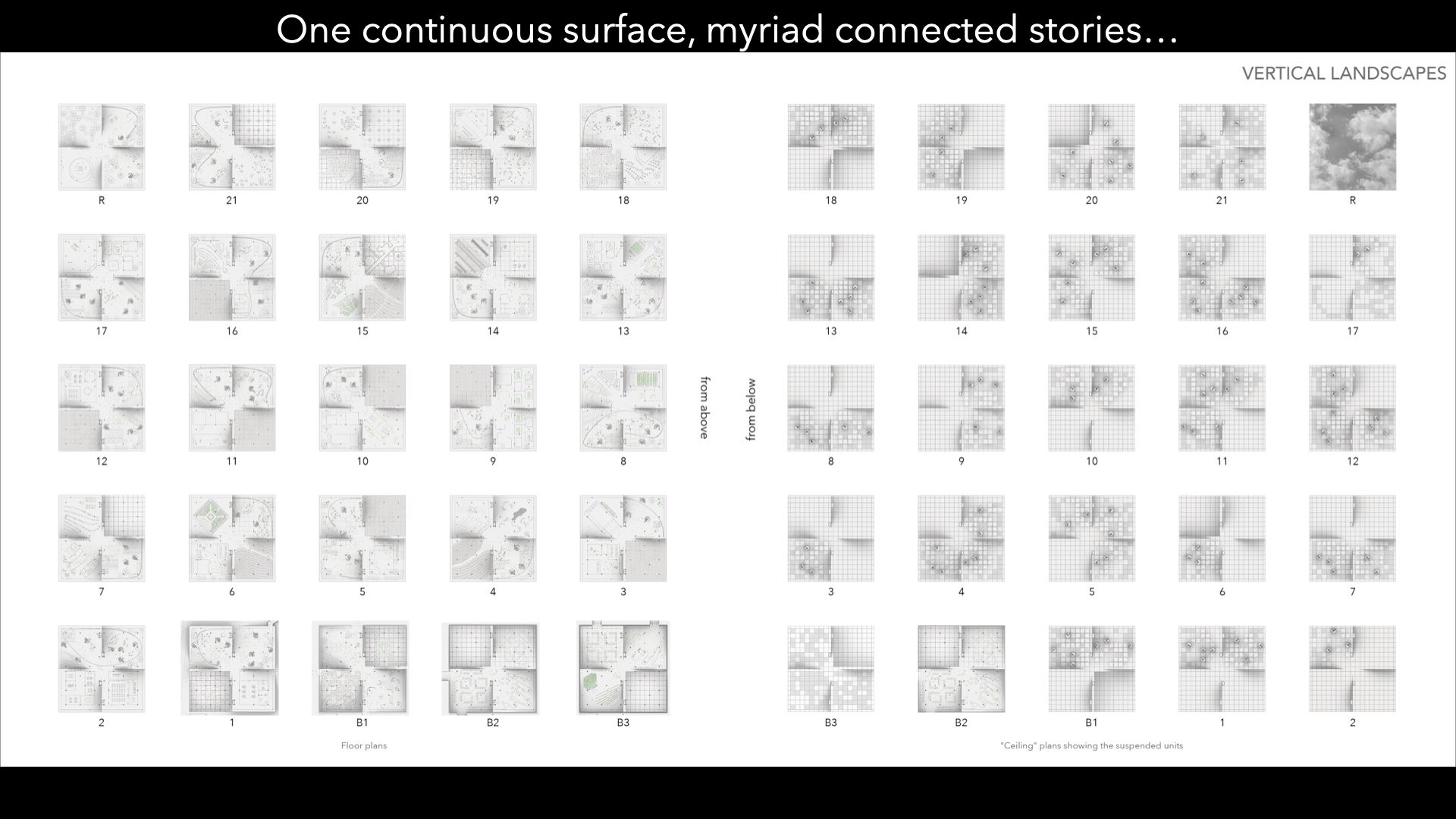
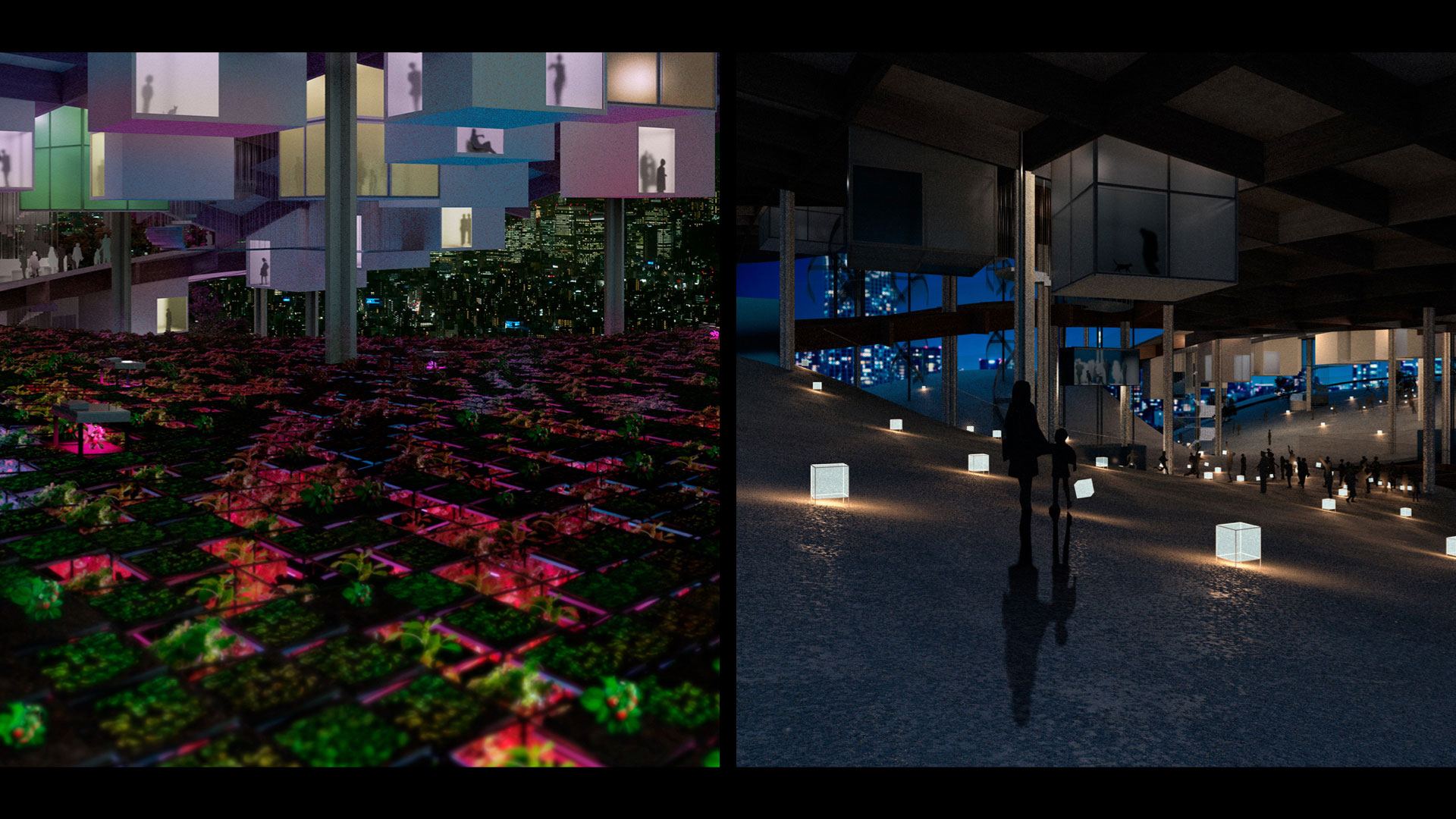
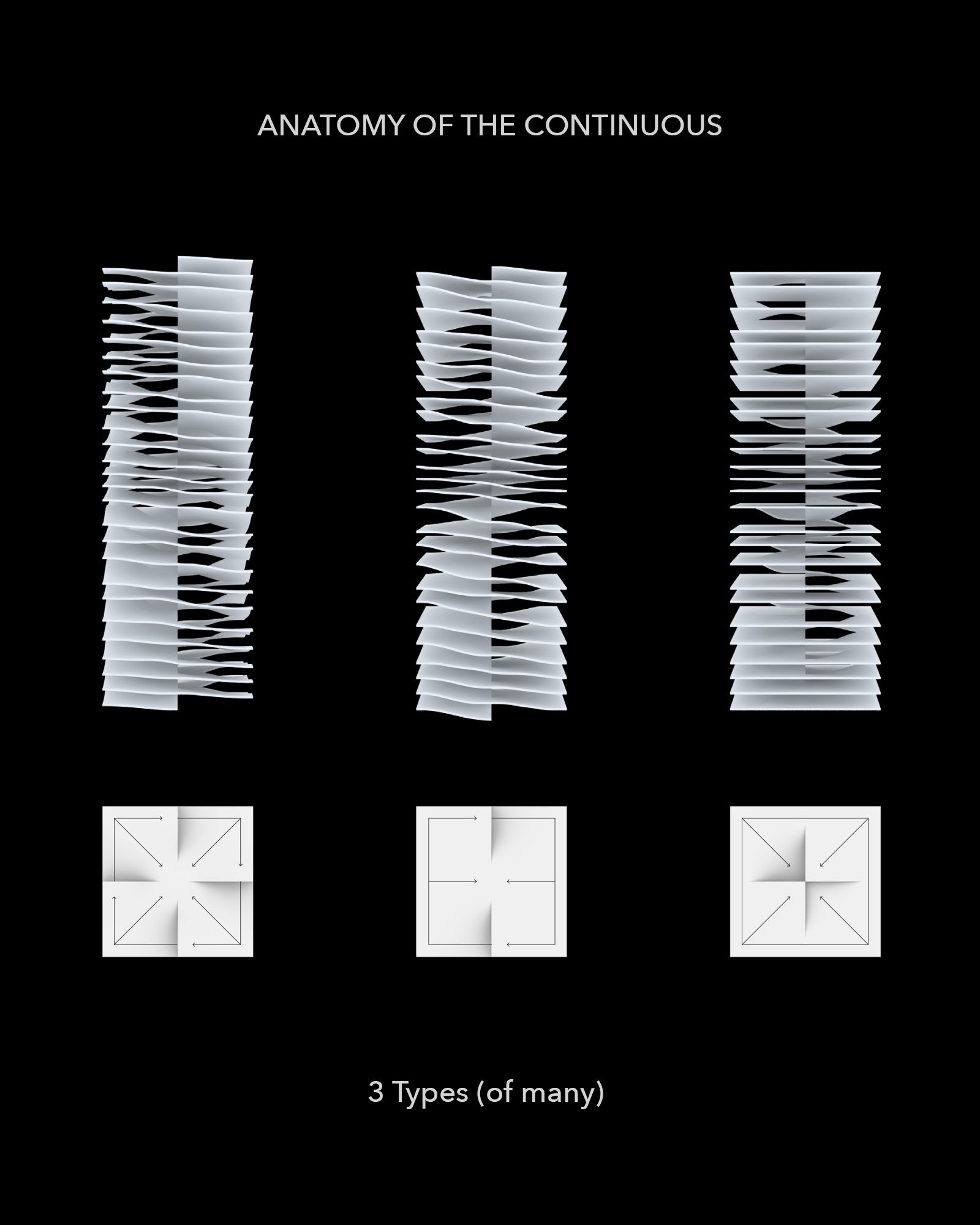
Vertical Landscapes do not fragment the urban fabric with disconnected objects. They extend the ground into the air: a new topography where buildings are suspended beneath while streets and parks continue above.
Once the ground becomes a multi-dimensional interface, low-rise intensities can be suspended beneath expansive aerial parks, allowing Tokyo’s characteristic shifts in scale to extend vertically.
Circulation
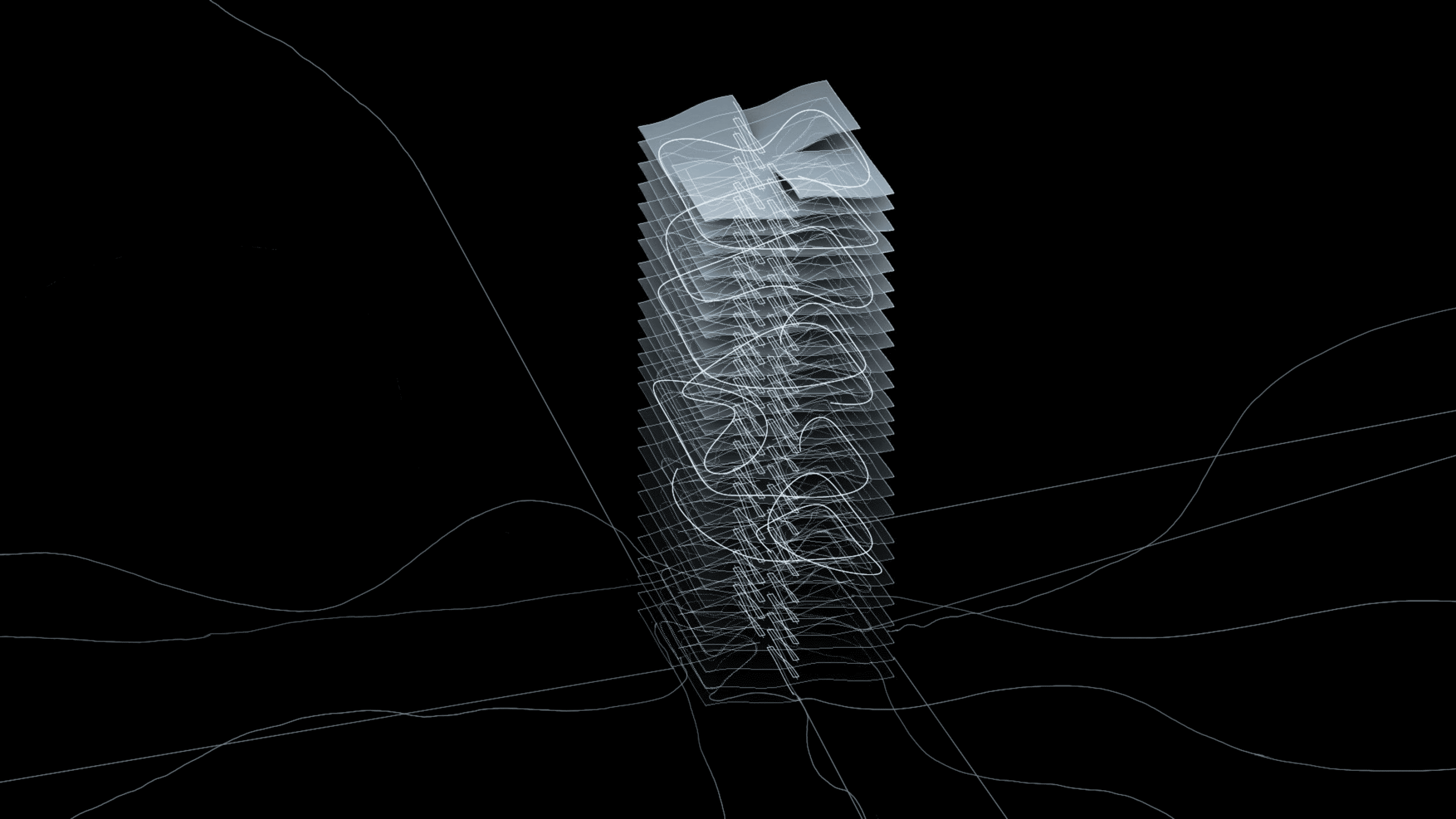
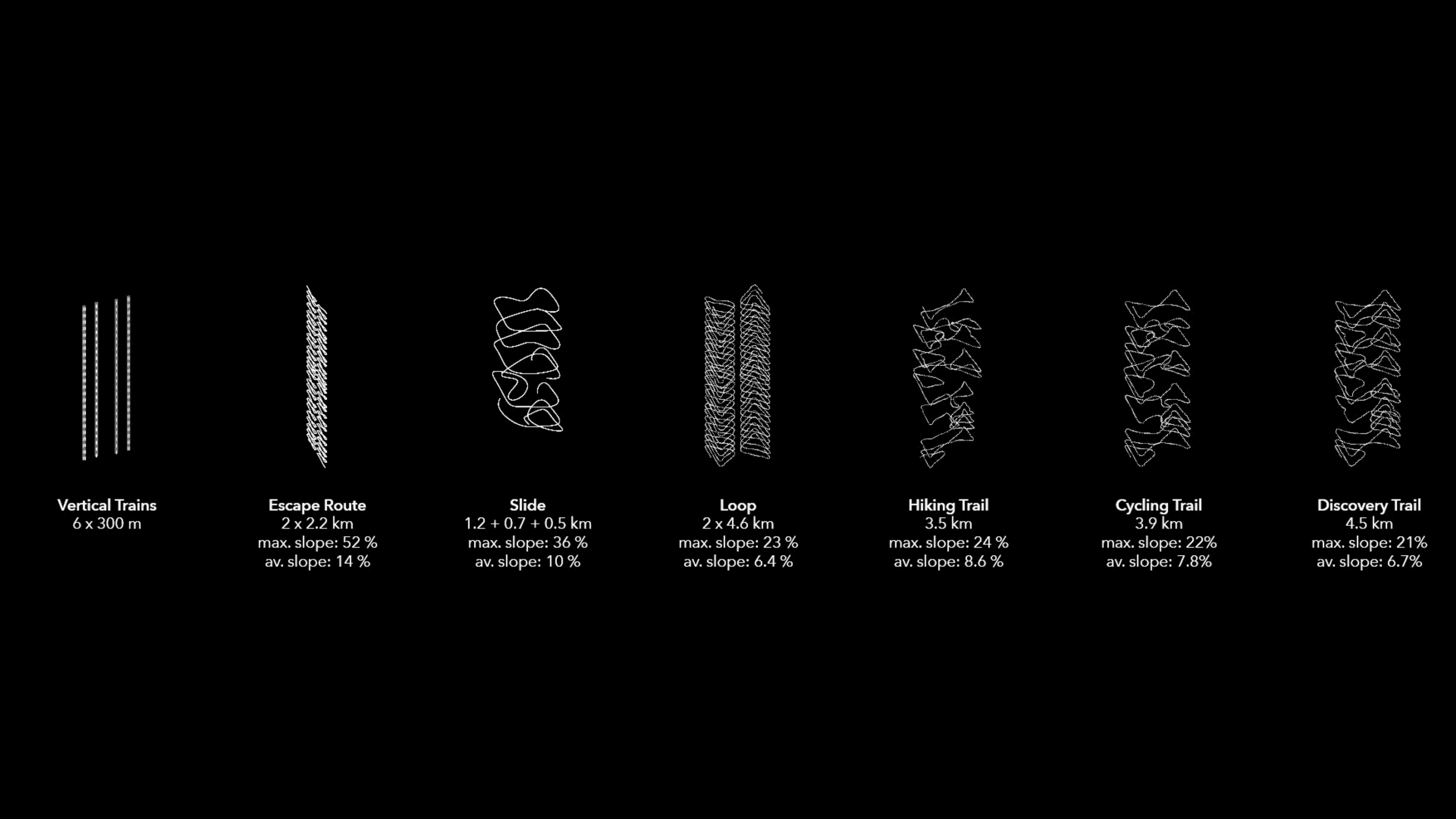
On a continuous surface, walking, running, and cycling become primary modes of movement. Conventional lifts are replaced by vertical trains operating on schedules rather than on demand, supporting rather than prescribing the main means of transport.
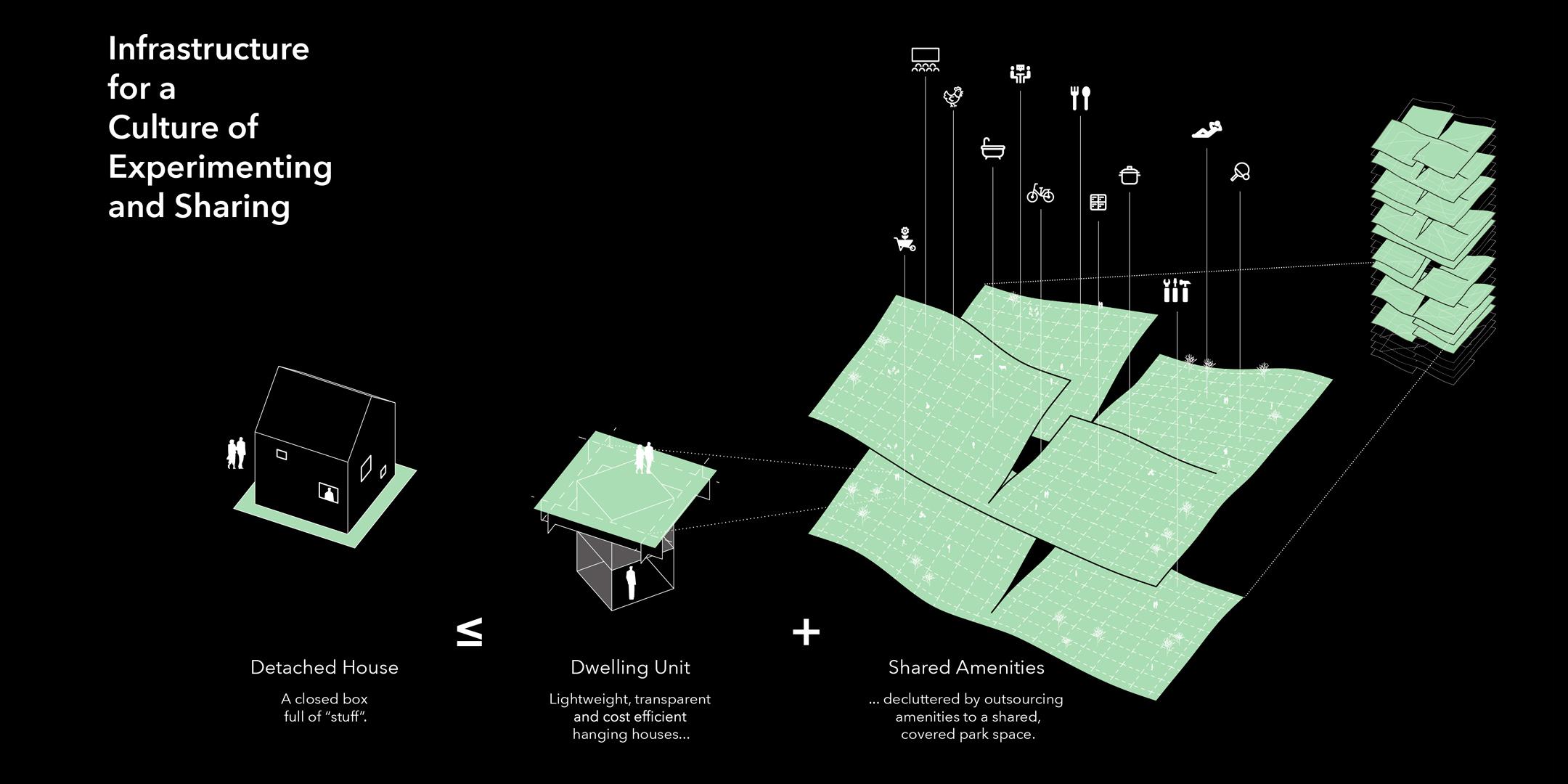
Movement through Vertical Landscapes is like movement through the city itself: continuous, open-ended, and shaped by adjacency and shared occupation. These spatial conditions foster another form of circulation — sharing. Vertical Landscapes provide a spatial framework for collective use, reflecting emerging forms of access beyond exclusive ownership.
Resilience
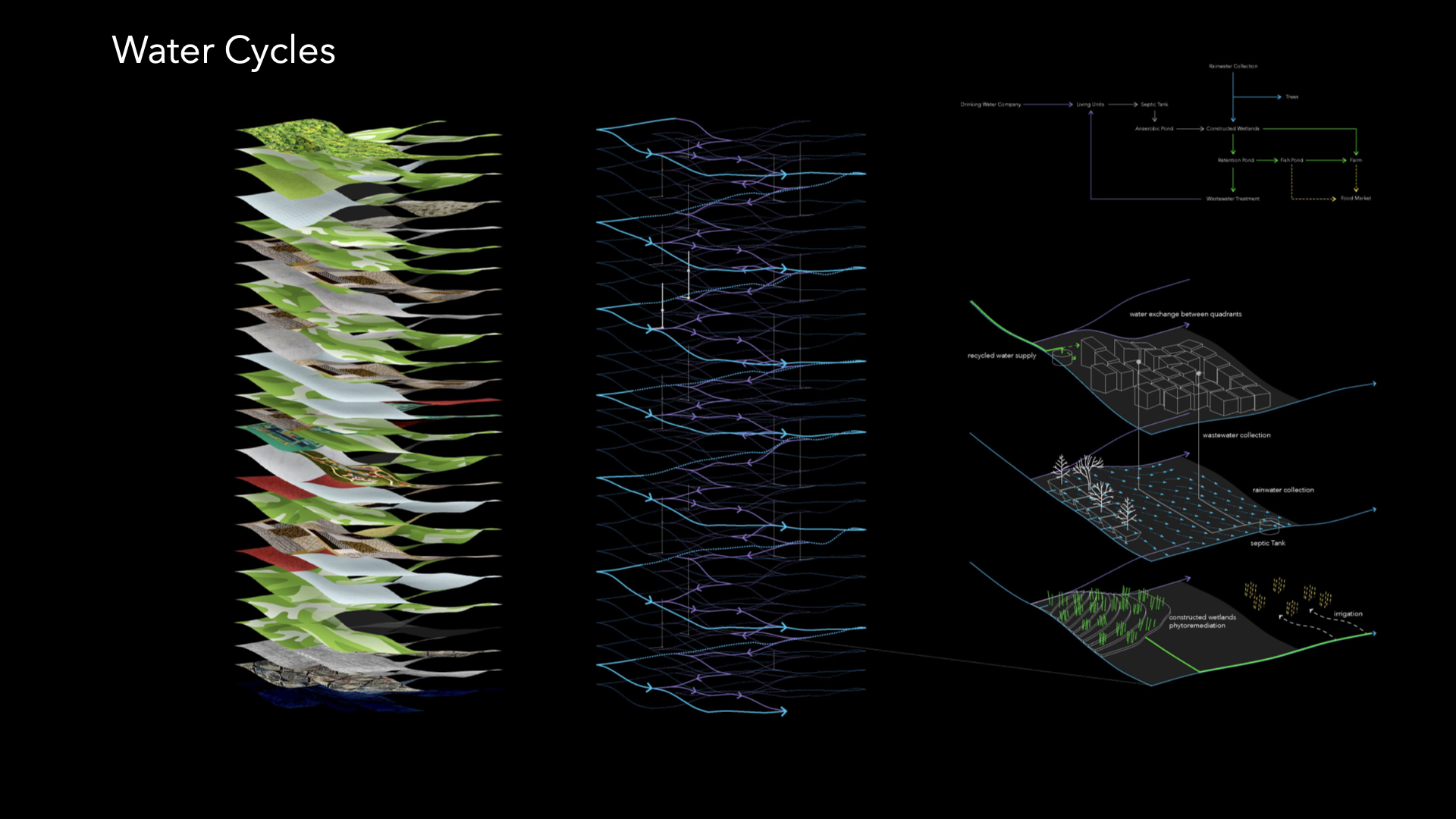
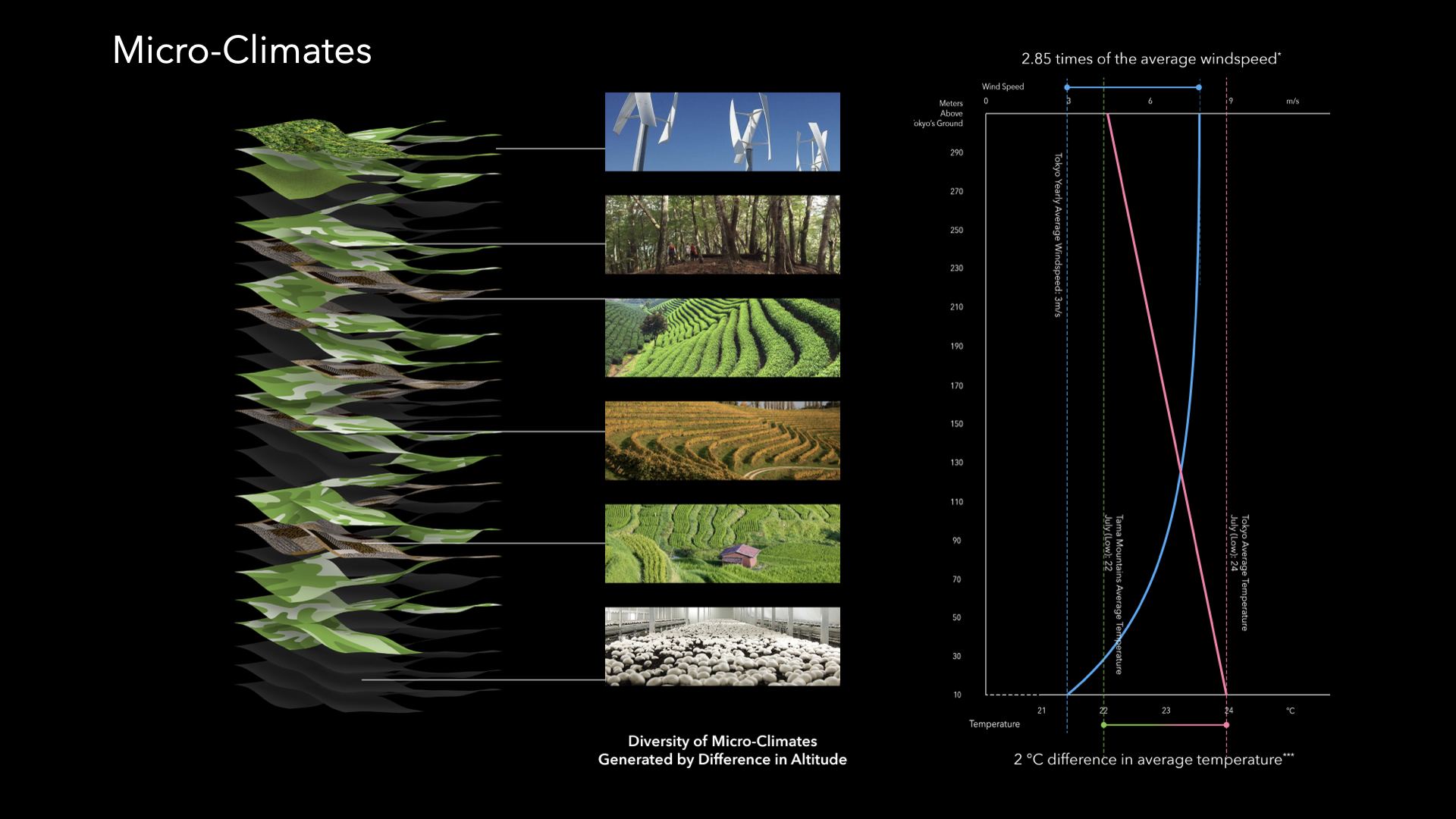
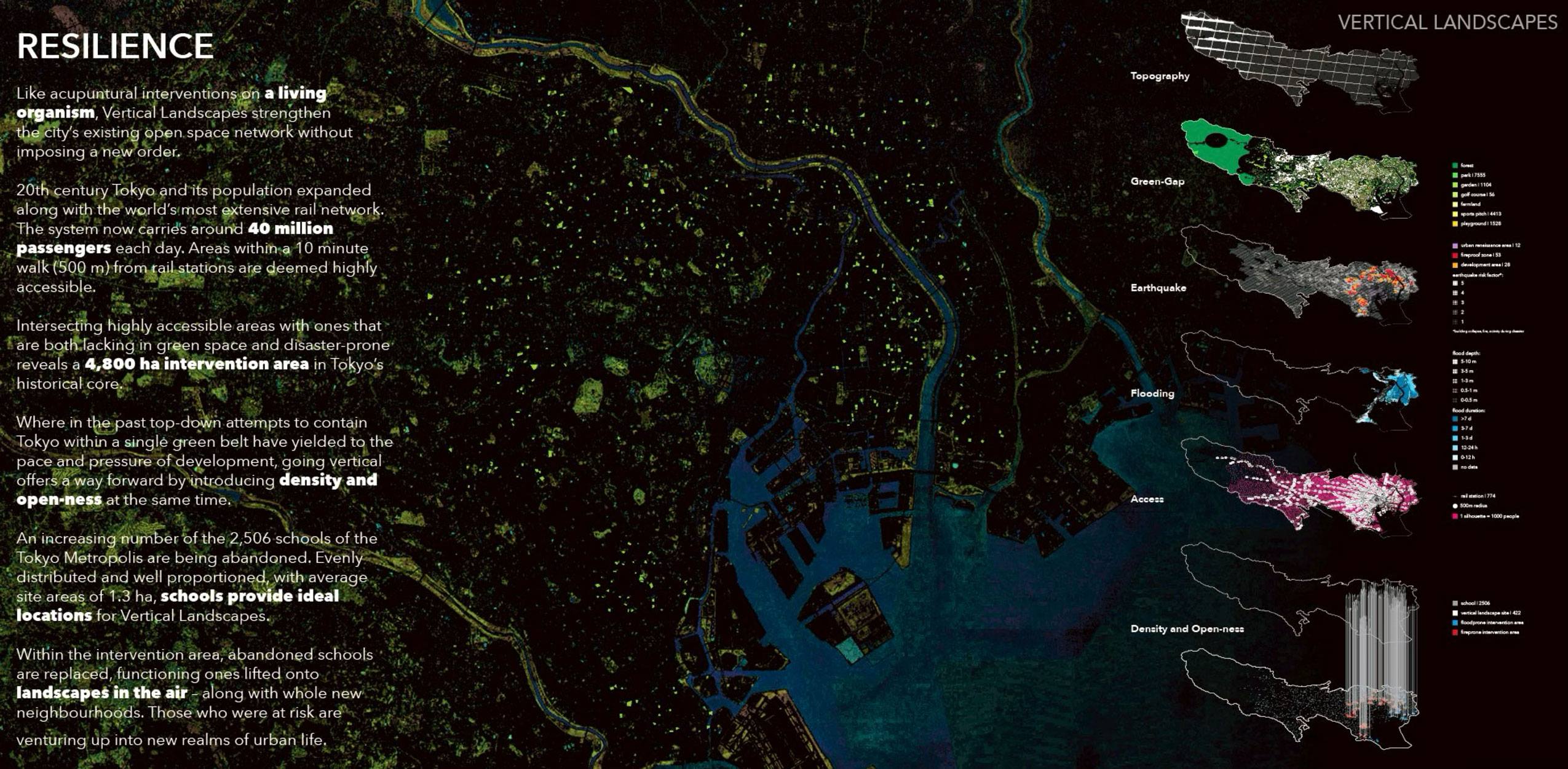
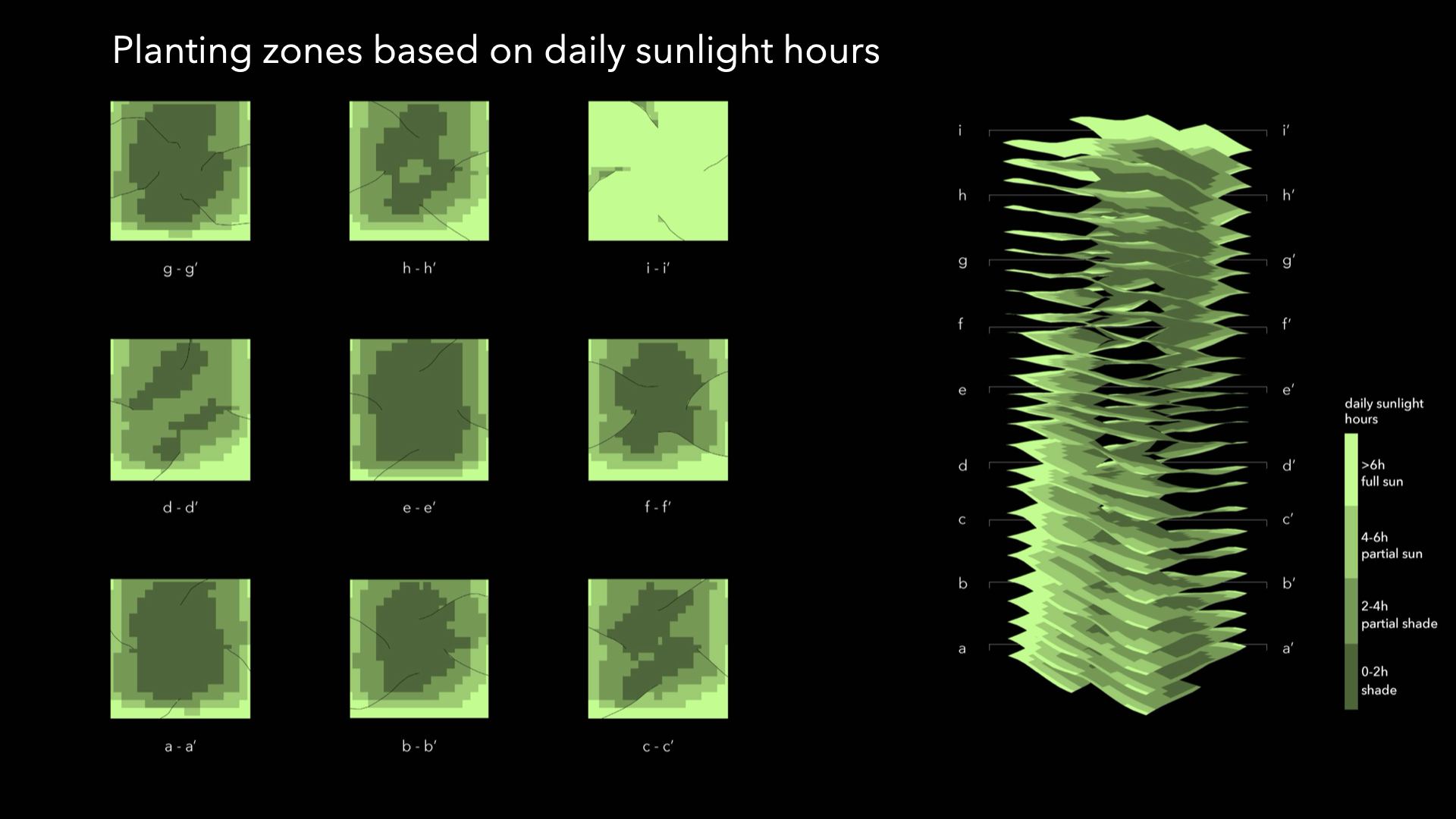
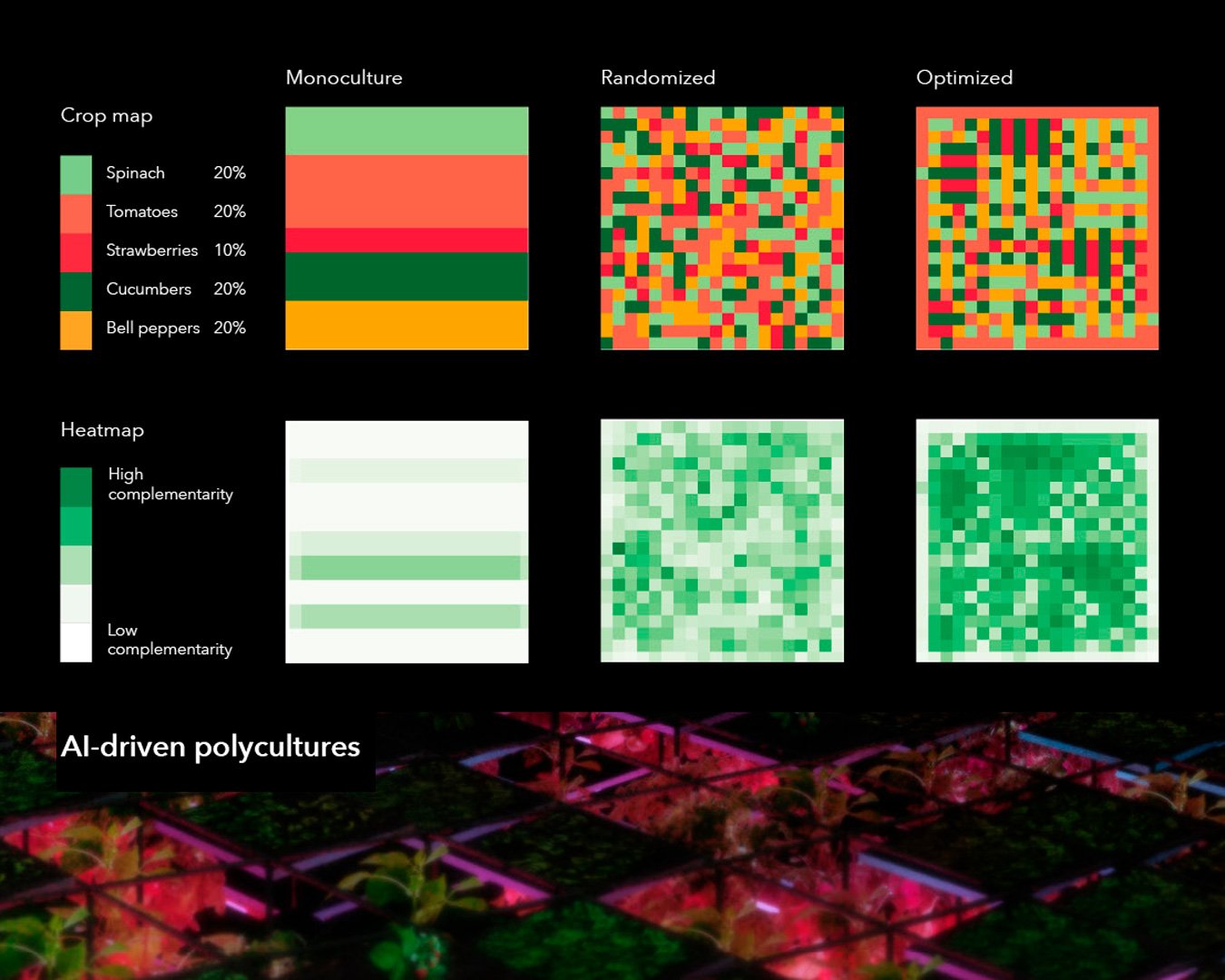
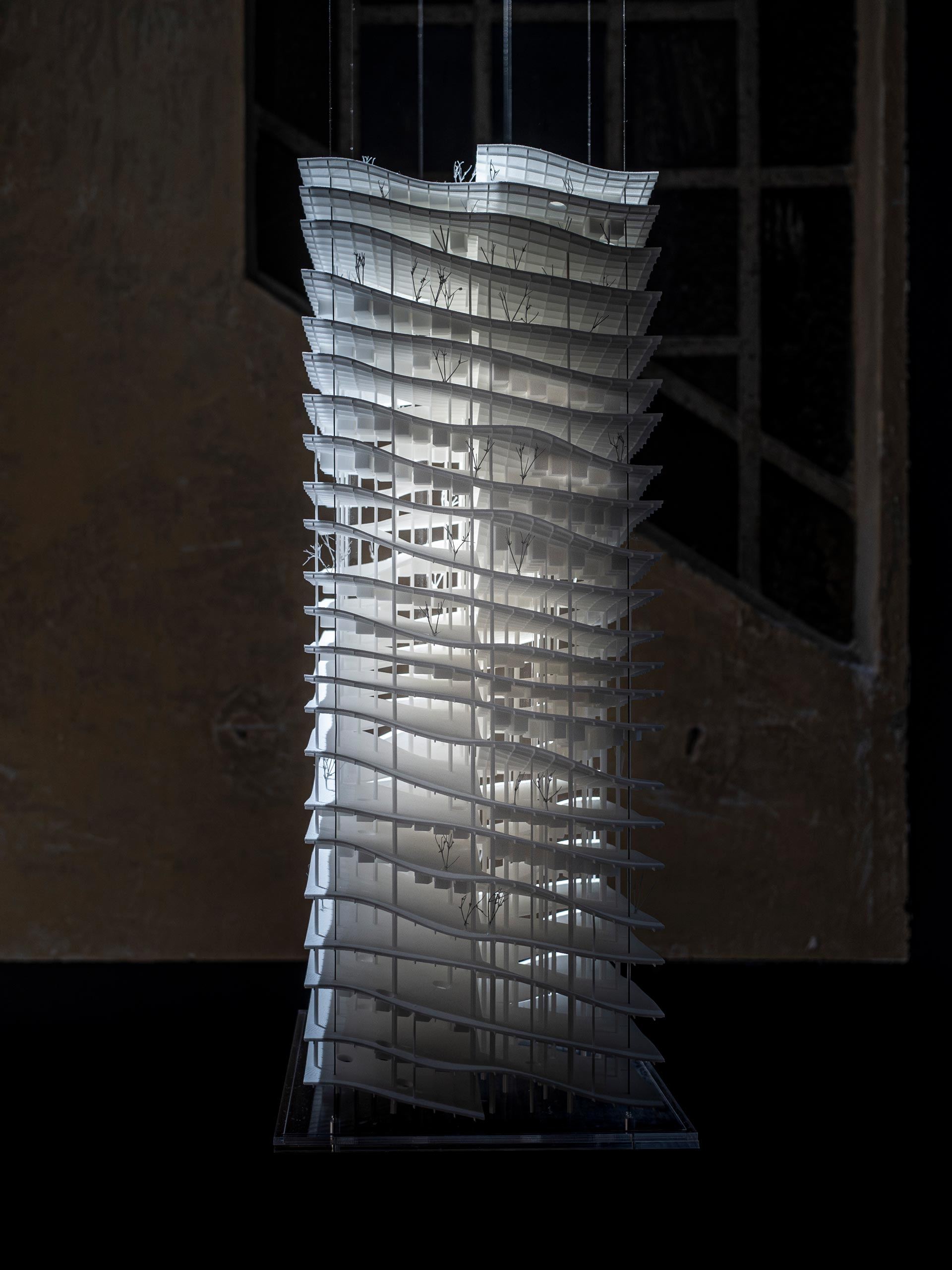
Vertical Landscapes are an ecosystem in which energy and water systems are integral to the structure. Variations in altitude, depth, and orientation produce distinct microclimates, allowing biodiversity to thrive within the city.
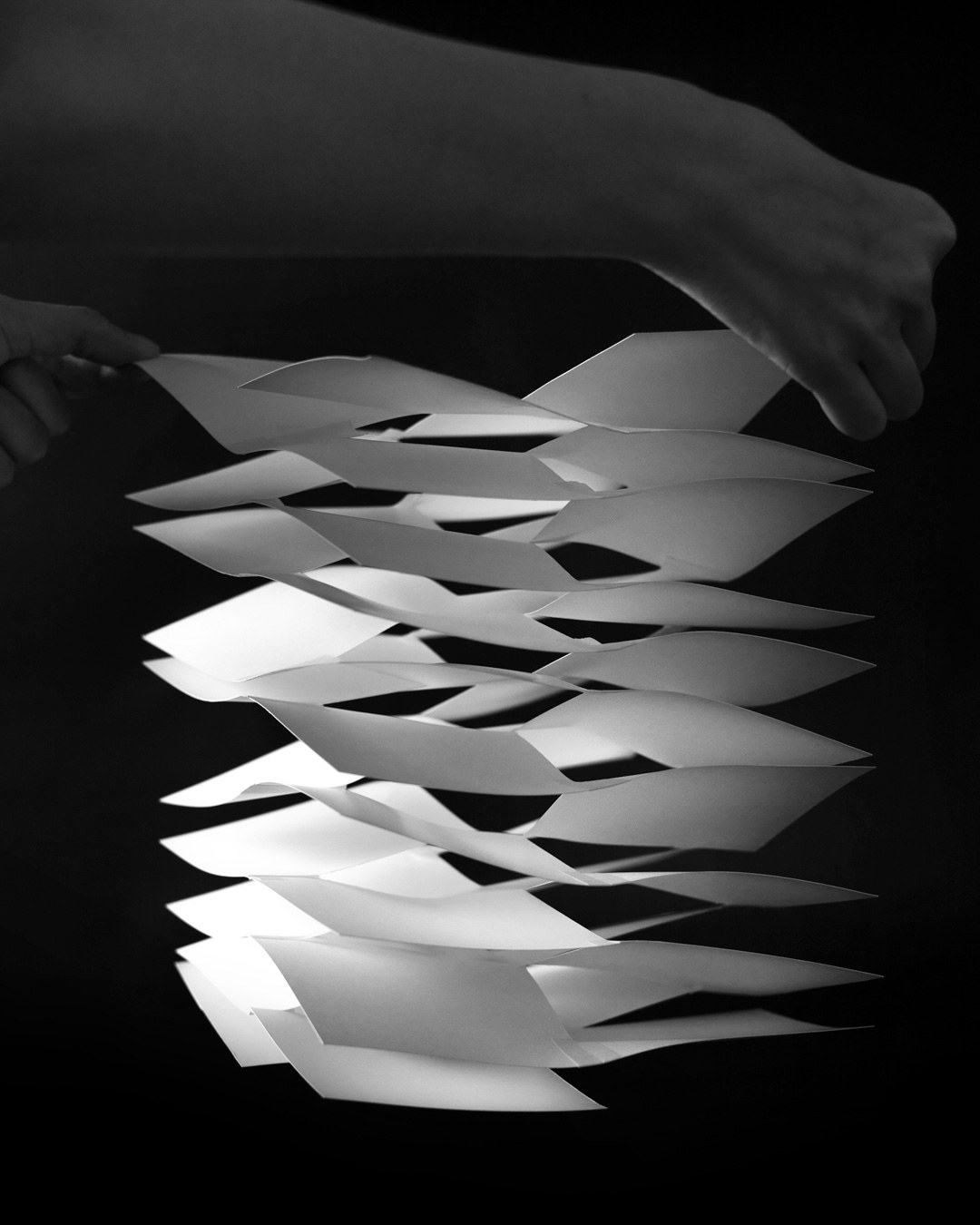
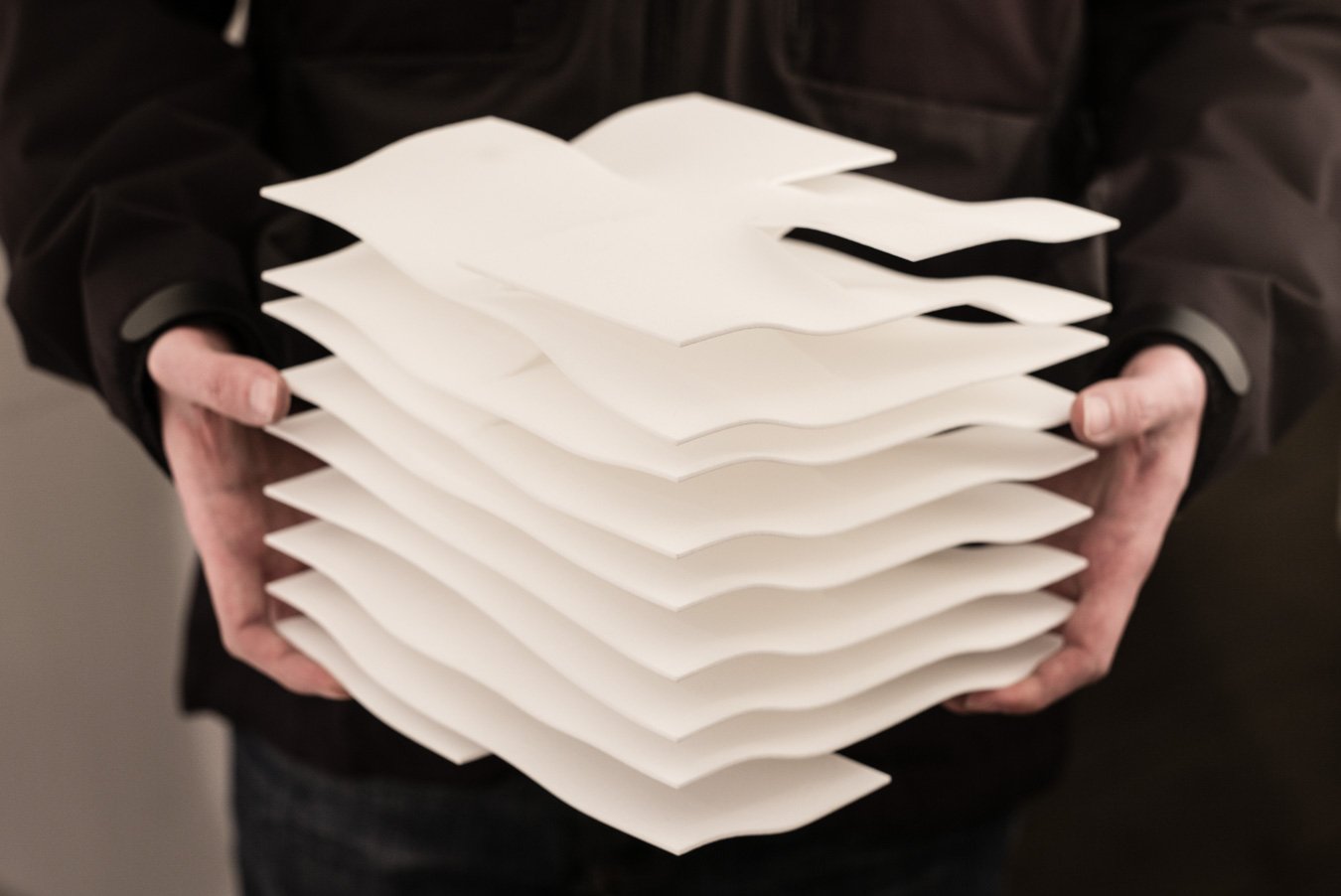
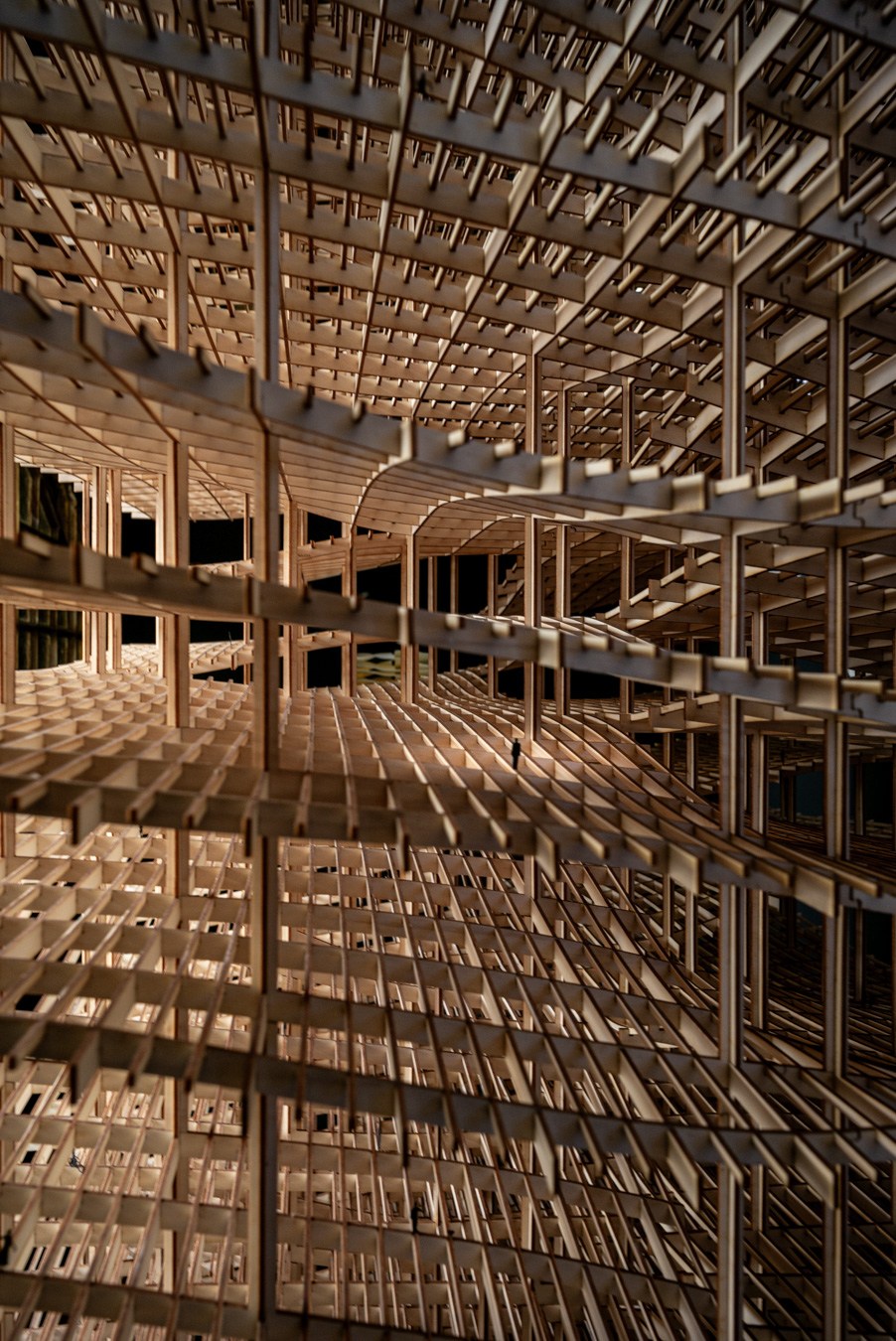
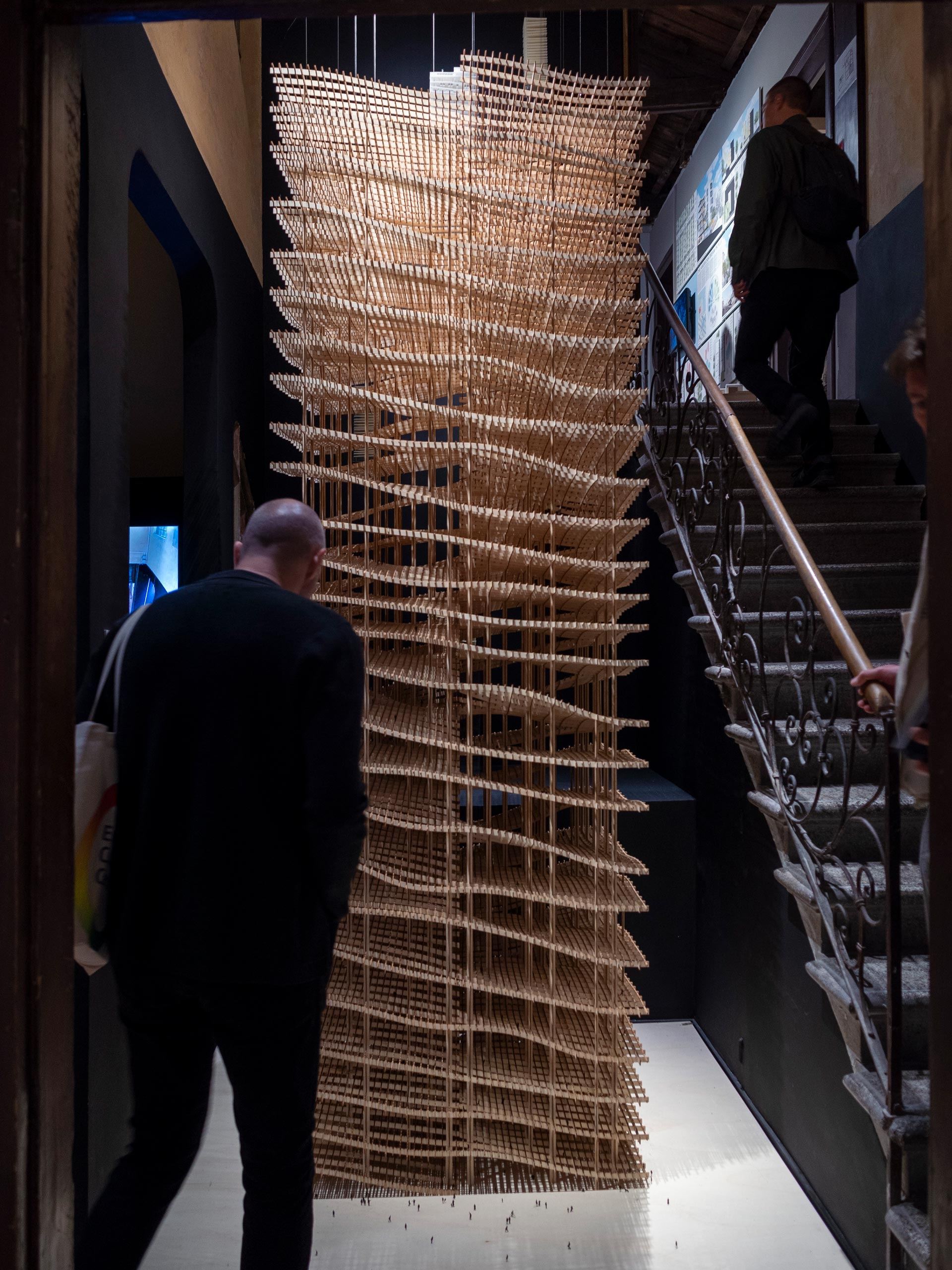
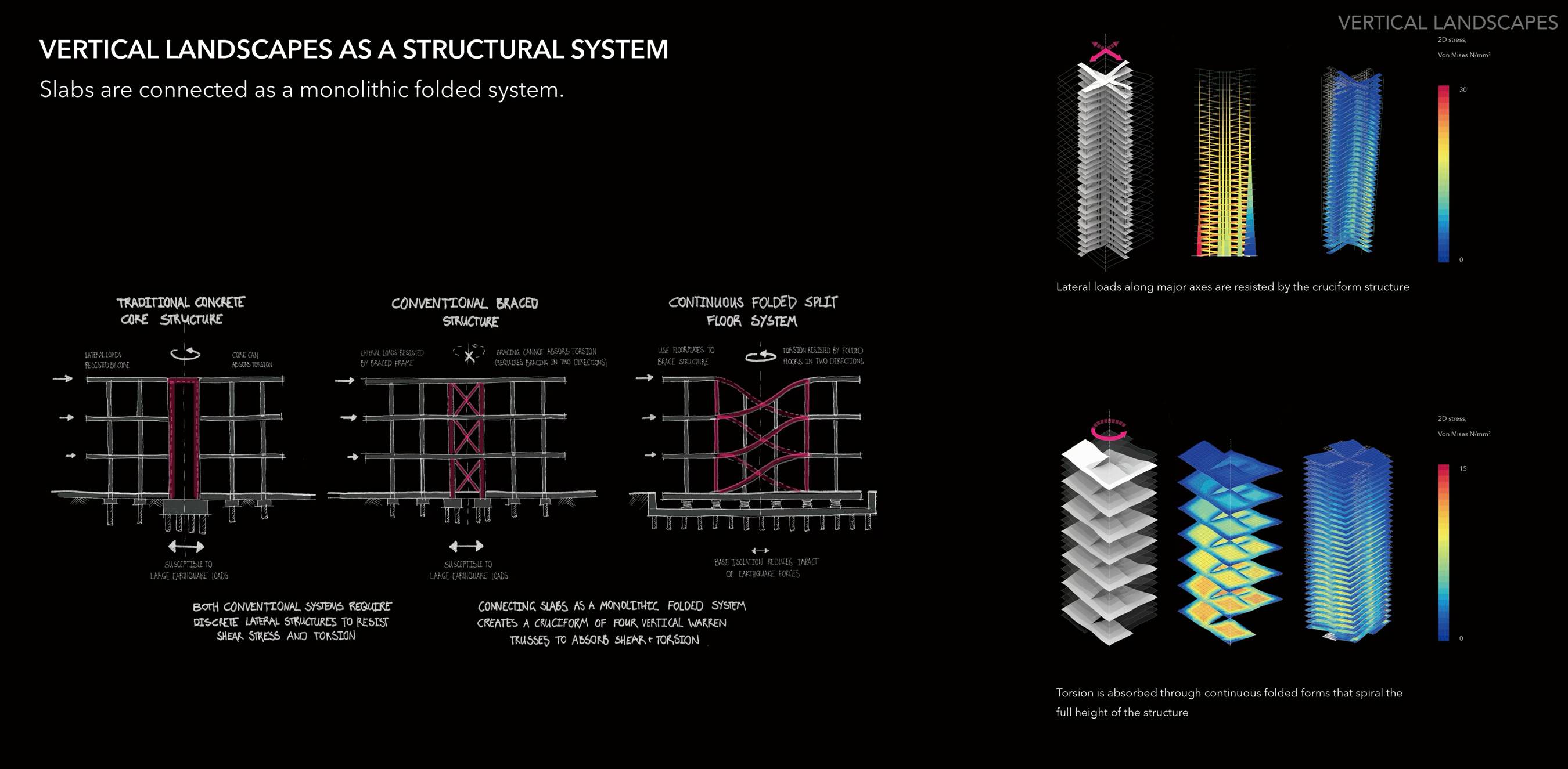
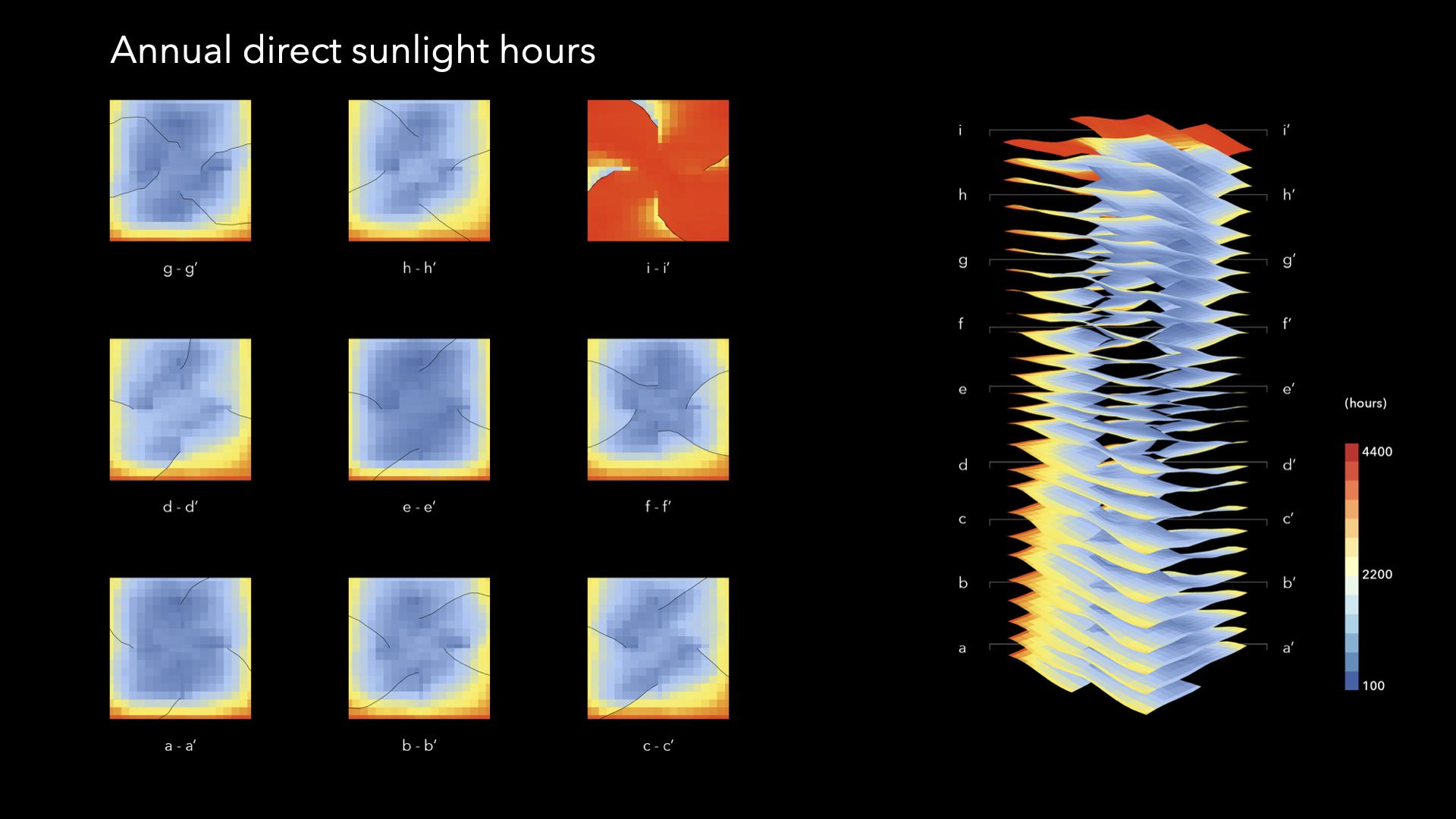
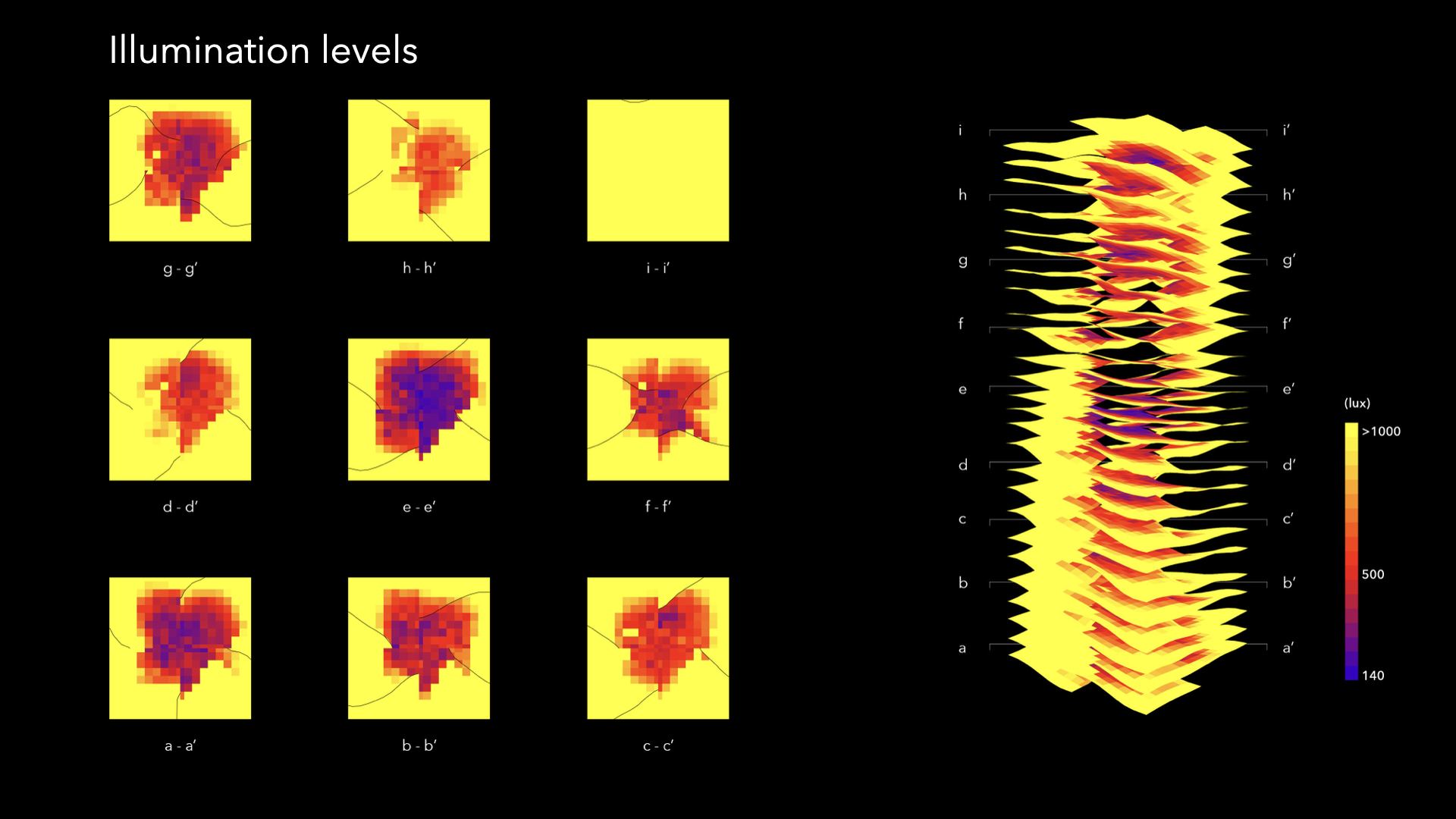
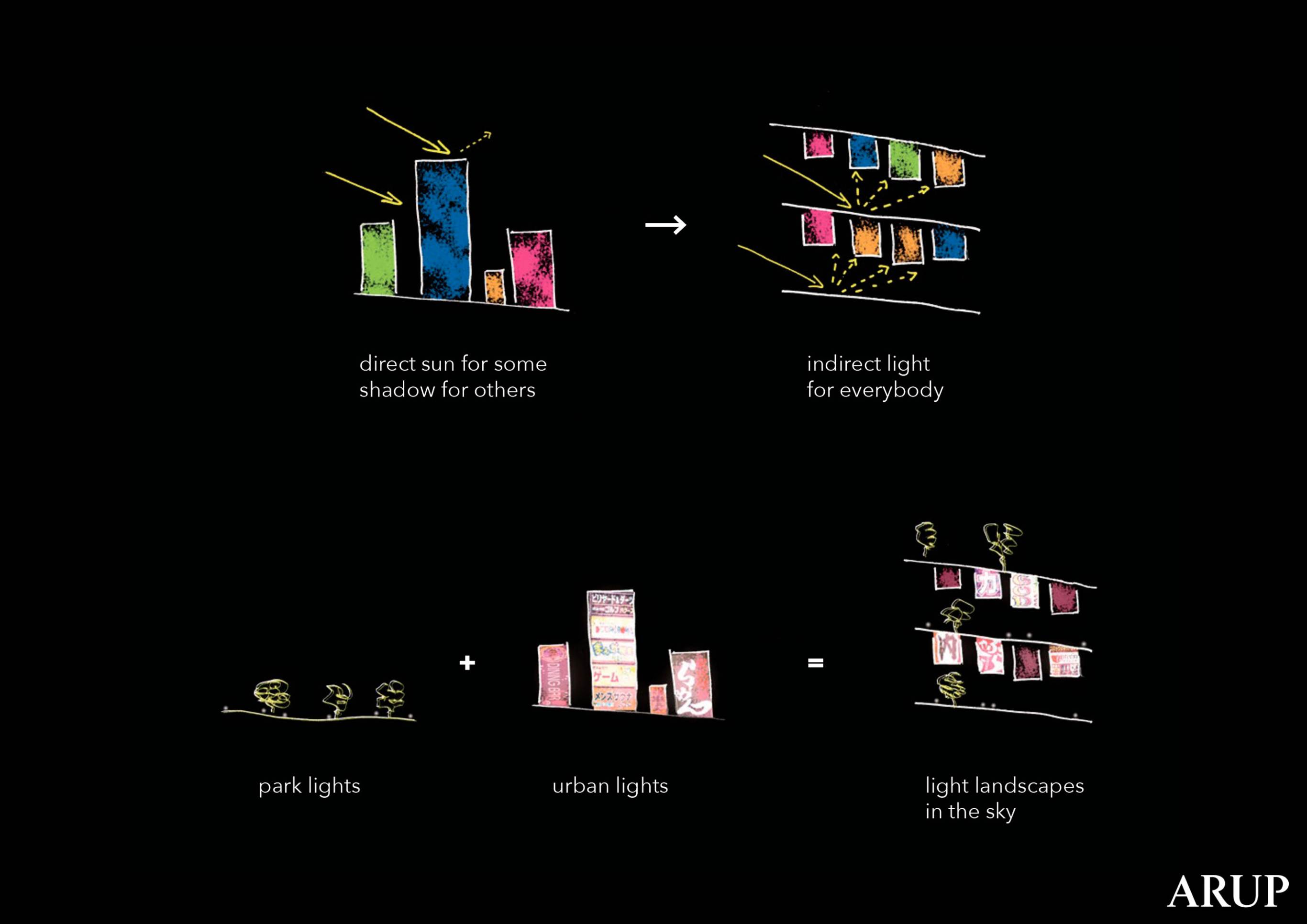
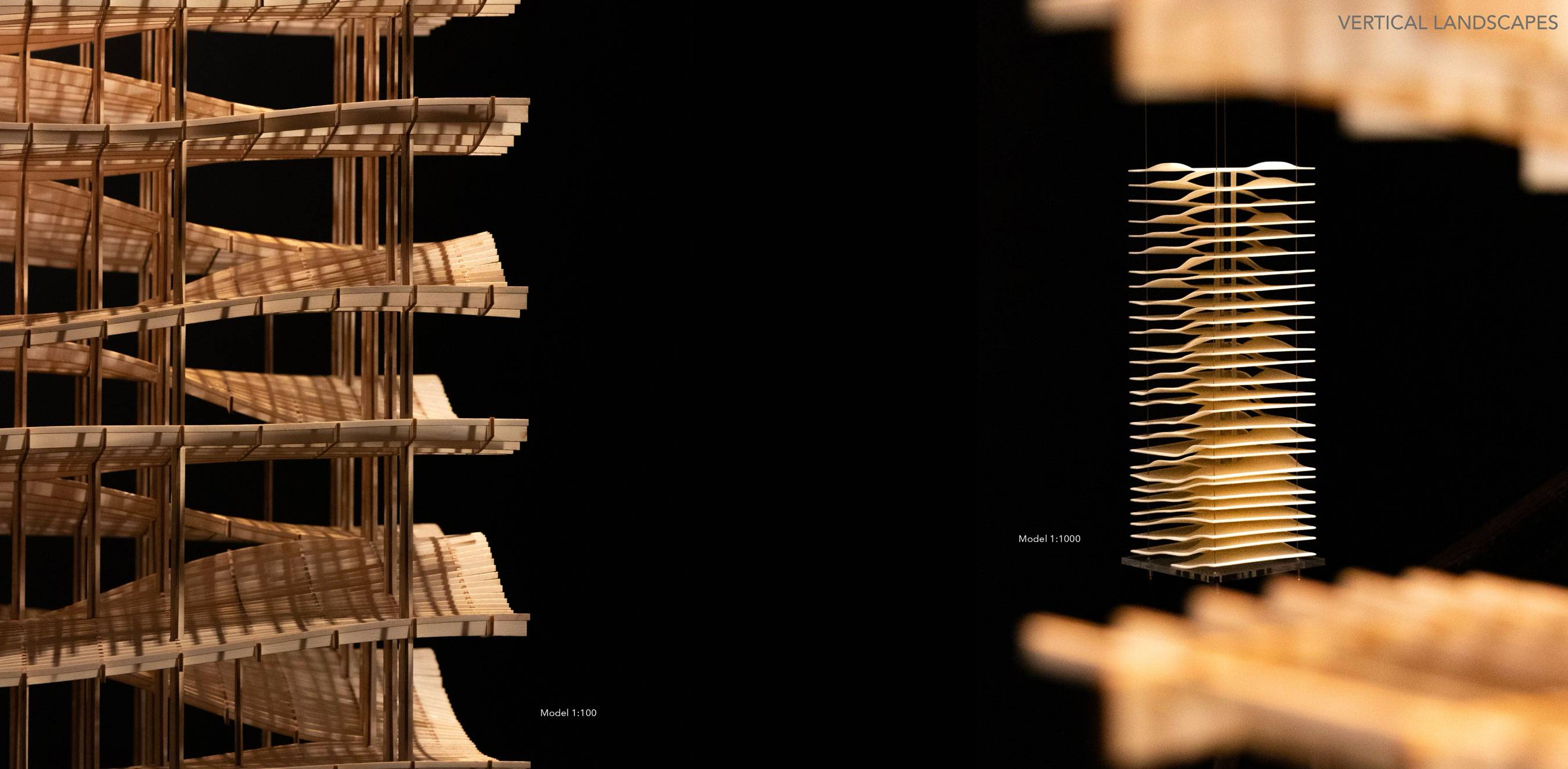
As rising sea levels and extreme rainfall increasingly threaten urban habitats, Vertical Landscapes enhance resilience by accommodating fluctuating water levels through a smooth interface with the ground. The structural system minimises material use through a monolithic folded configuration: an interlocking grid of glue-laminated timber beams and high-strength, concrete-filled steel columns forms a continuous system, eliminating the need for discrete lateral structures. The splayed geometry increases daylight penetration and reflection while expanding outward views.
Density of Openness
As density and openness cease to be opposites and become interdependent conditions, the city grows thicker without becoming heavier. By exploring the vertical as an extension of the urban outside, increasing density no longer means inserting isolated enclosures, but intensifying urban life through an openness that reinforces the city as a shared and adaptable habitat.
東京、そして世の中のあちこちの都会, 2015—2027
Type
Status
Team
フロリアン ブッシュ, ヨアキム ナイス, 岸井摩紀, 朱承哲, C. バウムガーテン, 木村 さくら, 大澤祐太朗, A. ハマトヴ (研修生), グスタヴ ボービ (研修生), F. スピーグル (研修生)
構造: ARUP (Andrew Johnson, George Target, Xavier Nutall)
環境: ARUP (ポール スローマン, Sasha Kravetz-Alsina)
ライティング・デザイン: ARUP (Tim Carr)
農業・エンジェニアリング: Braid
Size
Prototype "Arakawa":
Conventional GFA: 242,500 m² (top of surfaces)
Additional GFA: 179,200 m² (underside of surfaces)
Plots for Sale: 89,600 m² (for suspended building)
Height: 256 m (+44 m below grade)
Footprint: 100 x 100 m
Structure
Surfaces: Glue-laminated Timber Beams
Columns: Concrete Filled Plates (cruciform)
受賞
レクチャー
展示・展覧会
出版・掲載
関連プロジェクト:
- バーチカル・ランドスケープ, 2015—2027
- AVA Hirafu, 2025
- 昇, 2021—2023
- 第3倉庫, 2022
- CnP Project, 2018—2020
- Kita Unga Hotels, 2019
- I'T, 2019
- 神楽坂のYプロジェクト, 2017—2018
- 木曽町役場本庁舎, 2017
- 台中市立文化センター, 2013
- 東京・デザイン・ウイーク, 2011
- 越後妻有・オーストラリア・ハウス, 2011
- ドバイの輪, 2009
- RG プロジェクト, 2009
- バーチカル・ランドスケープ, 2015—2027
- CnP Project, 2018—2020
- リマ市立美術館, 2016
- 厳島港宮島口旅客ターミナル, 2016
- デトロイト・高架橋・ギャラリー, 2014
- 金門フェリーターミナル, 2014
- バーチカル・ランドスケープ, 2015—2027
- T 邸, 2021—2025
- 中富良野のW邸, 2022—2024
- 虚空のある家, 2022—2024
- 三番町の家, 2023—2024
- 昇, 2021—2023
- 有島のI邸, 2020—2023
- 永田台の「内にひらく家」, 2021—2023
- 伊豆高原のI邸, 2019—2021
- ヒラフ・クリークサイド, 2021
- 森の中の家, 2017—2020
- 神楽坂のYプロジェクト, 2017—2018
- ニセコのK邸, 2015—2017
- 千葉のS邸, 2011—2015
- 私たちのプライベートスカイ, 2013
- ヒラフのL邸, 2010—2013
- BL プロジェクト, 2012
- 吉佐美のA邸, 2009—2012
- 内にひらく家, 2011—2012
- 高田馬場の家, 2010—2011
- F&Fプロジェクト, 2011
- 斜面の家, 2011
- 土気 7, 2010
- 雪の中の二軒, 2009—2010
- 軽井沢の家, 2009
- RG プロジェクト, 2009
- バーチカル・ランドスケープ, 2015—2027
- CnP Project, 2018—2020
- バーチカル・ランドスケープ, 2015—2027
- 第3倉庫, 2022
- リマ市立美術館, 2016
- 同志社大学チャペル, 2012
- デグゴサン市立図書館, 2012
- バーチカル・ランドスケープ, 2015—2027
- Architecture and Design Museum Helsinki, 2024
- I'T, 2019
- カウナス・サイエンス・アイランド, 2016
- リマ市立美術館, 2016
- K8, 2014—2015
- デトロイト・高架橋・ギャラリー, 2014
- ハンガリー音楽博物館, 2014
- グッゲンハイム・ヘルシンキ, 2014
- 太田市文化交流施設, 2014
- 台中市立文化センター, 2013
- ベルリン未来館, 2012
- 東京デザイナーズウィーク アート・ギャラリー, 2011
- 東京・デザイン・ウイーク, 2011
- RG プロジェクト, 2009
- 東京・ベルリン|ベルリン・東京, 2006
- バーチカル・ランドスケープ, 2015—2027
- AVA Hirafu, 2025
- 第3倉庫, 2022
- バーチカル・ランドスケープ, 2015—2027
- I'T, 2019
- リマ市立美術館, 2016
- 太田市文化交流施設, 2014
- 台中市立文化センター, 2013
- ベルリン中央図書館, 2013
- デグゴサン市立図書館, 2012